The Shunka Warak’in: A Cryptid Bridging Native Lore and Pioneer Tales…

And now for something completely different… this weird creature called the Shunka Warak’in. Often dubbed the “Rocky Mountain Hyena” or simply “the Beast,” this wolf-like creature has slinked through Native American folklore and settler tales,and maybe even the Ice Age.

Roots in Native American Lore: The Dog-Snatcher of the Plains

Long before European settlers arrived, the Shunka Warak’in was a figure in Native American traditions, particularly among the Ioway (Iowa) tribe and neighboring groups like the Lakota and Shoshone in the Great Plains and Midwest regions. The name itself, “Shunka Warak’in,” translates roughly to “carries off dogs” in the Ioway language, fitting for a beast notorious for sneaking into villages under the cover of night to snatch canines right from under their owners’ noses.

Descriptions from oral histories paint it as larger than a wolf, with dark, shaggy fur, high shoulders, and a sloping back that gives it a hyena-like silhouette. It wasn’t just a scavenger; this cryptid was bold, aggressive, and eerily unintimidated by humans or campfires. Tribes like the Ioway distinguished it clearly from ordinary wolves, they knew their local wildlife intimately, and this was something else to them.

One tale, shared by Ioway historic preservationist Lance Foster, recounts a fierce battle where warriors slew a Shunka Warak’in. Victorious, they fashioned pieces of its hide into sacred war bundles or medicine pouches, believing the creature’s resilience would make them “as hard to kill” as the beast itself. In these cultures, the Shunka Warak’in wasn’t merely a monster; it symbolized the perils of the untamed frontier.

Pioneer Encounters: Excerpts from a Naturalist’s Memoir

Fast-forward to the late 1800s, when white settlers in Montana’s Madison River Valley began reporting encounters that eerily mirrored the Native tales. The most famous account comes from rancher Israel Ammon Hutchins, whose story was immortalized by his grandson, zoologist Ross E. Hutchins, in the 1977 book Trails to Nature’s Mysteries: The Life of a Working Naturalist (with a 1997 reprint).

Hutchins recounts his grandfather’s chilling brushes with the creature in vivid detail. One excerpt describes an early sighting:

“One winter morning my grandfather was aroused by the barking of dogs. He discovered that a wolf-like beast of dark color was chasing my grandmother’s geese. He fired at it but missed and ran off towards the river.”

The beast returned repeatedly, prompting more confrontations. Eventually, Israel succeeded: “Then one morning in late January, my grandfather was alerted by the dogs, and this time he was able to kill it.” Witnesses described it as “nearly black and having high shoulders and a back that sloped downward like a hyena.”

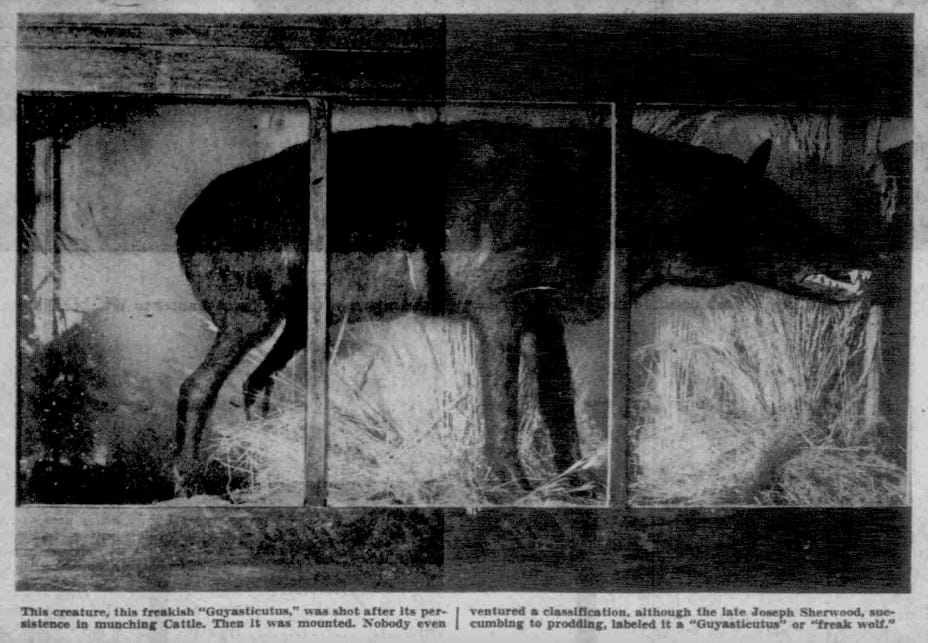
The carcass was traded to taxidermist Joseph Sherwood, who mounted it and displayed it as the “ringdocus” or “guyasticutus”, quirky names for what became a local curiosity. It vanished for decades, known only from a grainy photo in Hutchins’ book, until its rediscovery in 2007 at the Idaho Museum of Natural History (now on display at the Madison Valley History Association Museum in Ennis, Montana).
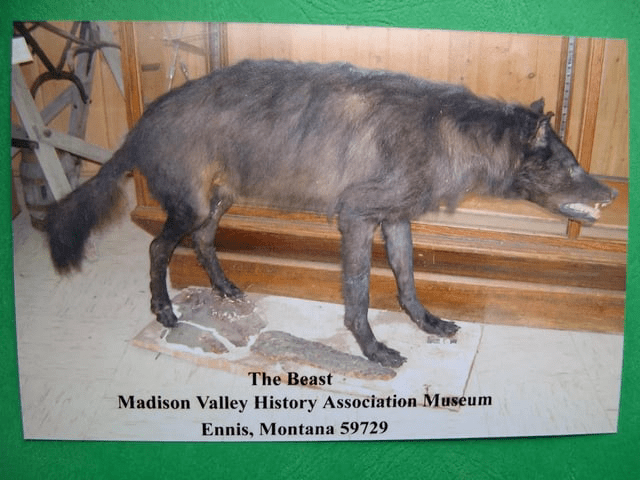
Ross Hutchins, with his scientific background, couldn’t classify it definitively, speculating it might be an escaped hyena but noting the improbability.

Echoes from the Ice Age: The Running Hyena Connection

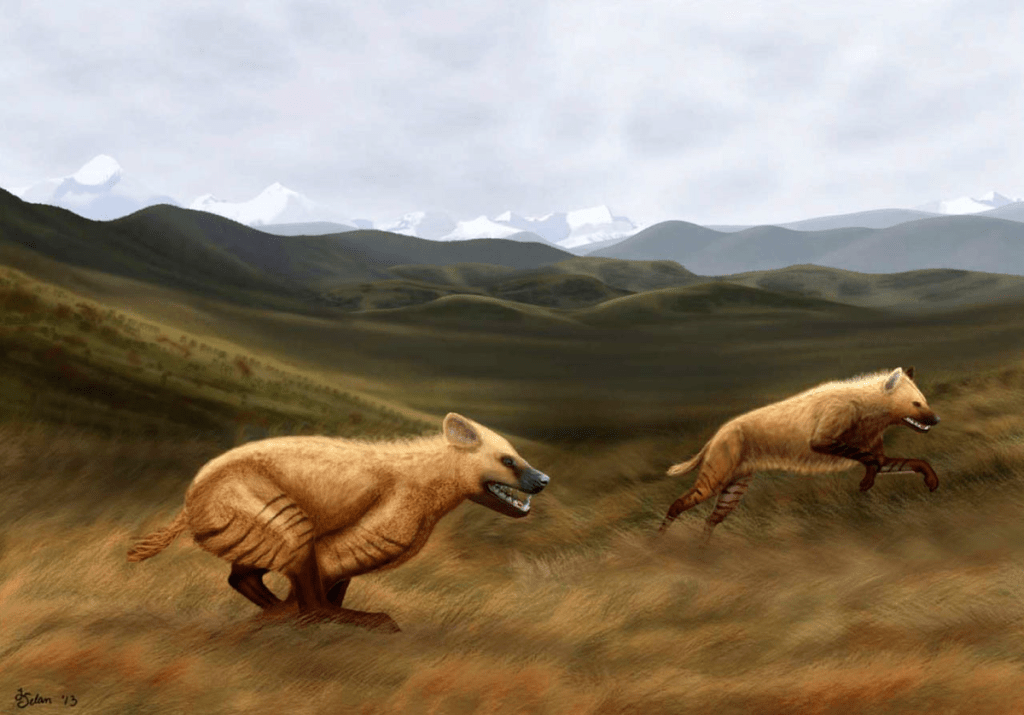
What if the Shunka Warak’in isn’t just myth or legend, but a remnant of prehistoric North America? Cryptozoologists often compare it to Chasmaporthetes ossifragus, the “running hyena” or “American hyena”, an extinct species that roamed the continent during the Pliocene to Pleistocene epochs (about 4.9 million to 780,000 years ago).

Unlike the bone-crushing hyenas of today, Chasmaporthetes was built for speed with long legs for chasing prey across the grasslands, with a hyena-like build but more wolfish agility. Originating in the Old World (possibly Africa, Europe, or Asia), it crossed the Bering Land Bridge into North America around 5-3 million years ago, spreading south to areas like Arizona, Texas, Florida, and Mexico. Fossils are rare and fragmentary, but recent finds extend its range northward, even into Beringia and above the Arctic Circle.

This was a top predator on the Pleistocene plains, hunting pronghorns and other fast game. Its sloping back and powerful shoulders match Shunka descriptions, fueling theories of a relict population surviving into modern times perhaps even explaining those pioneer sightings.
Wrapping Up the Mystery: Fact, Fiction, or Fossil Survivor?

The Shunka Warak’in has sightings reported from Ioway warriors, Montana ranches and possibly Ice Age fossils. Is it a misidentified wolf? An escaped exotic pet? Or maybe did this creature survive, evolve and adapt from its ice age ancestors?

Have you heard of or had an encounter with this cryptid of legend, let me know…

Have a great Thursday!

Bigfoot or a Neanderthal…

In the late 1960s, a Soviet historian became fascinated with reports of a giant ape-like beast roaming the mountains of Central Asia. His obsession led him to develop an elaborate theory that these sightings were not of a mysterious cryptid, but of surviving Neanderthals who had endured since the last ice age.

Born in 1905, Boris Porshnev was a Soviet historian who dedicated much of his career

to studying mainstream academic topics, like popular uprisings in 17th-century France and the Thirty Years’ War. However, his scholarly pursuits were later peppered with an unorthodox interest in cryptozoology, especially the strange reports of the so-called Almas.

For centuries, reports of the Almas have emerged from people living within the mountain system of Central and East Asia, including Mongolia, the Altai and Tian Shan Mountains, Xinjiang, Gansu and Qinghai in China, and the Tuva Republic in Siberia.

As reports continued to surface, Porshnev secured approval from the Soviet Academy of Sciences in the 1950s to formally investigate the Almas. In 1958, he led an expedition to the Pamirs of Tajikistan, accompanied by a team of folklore experts, geologists, and botanists. After collecting a load of anecdotal reports about local sightings, the commission compiled a 400-page report on the topic, concluding that the Almas was most likely real and residing in the region between the Tian Shan, Pamir, and Mongolia. 

After the expedition, Porshnev began to suggest that the Almas were, in fact, a living Neanderthal. He had flirted with the idea in previous publications, but it was most explicitly laid out in his 1974 book called L’Homme de Néanderthal est toujours vivant (French for Neanderthal Man is Still Alive), co-authored with explorer and prominent cryptozoologist Bernard Heuvelmans.

“One must say that Porshnev and I were both quite convinced of the existence of wild hairy men in the broadest and loosest sense,” Heuvelmans wrote in the intro to Porshnev’s other book, The Struggle for Troglodytes.

“However, there was a point on which we never managed to agree: I saw the Himalayan snowman as an anthropoid ape while Porshnev saw an actual human, more specifically a Neanderthal man survivor from the recent Pleistocene,” he added. Fossilized remains of the extinct hominin species have been uncovered in this part of world.

You can read more from IFL Science’s article Here

But what do you think about his theory? I have always been on a line believing more that what ever this creature turns out to be, they have likely been here along. After all we know now thanks to more recent findings that several different types of hominids were existing side by side, might the infamous cryptid wandering out forests be one of them. I think yes. Man? Ape? Something in between most likely.

Maybe some day we’ll know for sure, hopefully in our lifetime…

Have a great day everyone and please I’d love to hear your thoughts…

Camper shares terrifying ‘Big Foot’ encounter miles away from Sasquatch-sighting hotspot | Daily Mail Online

A terrified camper claims he was left cowering in his tent after being woken up by the 15-foot sasquatch.
— Read on www.dailymail.co.uk/news/article-14473615/Camper-Big-Foot-encounter-Sasquatch-sighting-hotspot.html

Bigfoot sighting In Pennsylvania…

Pennsylvania man says that a during a recent hunting trip he was stalked by Sasquatch getting a close-up view of the creature’s face. The incident took place on February 19th on game lands near Penn State, where he goes to school. Identified as ‘M.K.,’ he was hunting for raccoons that evening when he suddenly heard an unnerving sound that he likened to someone striking a tree with a bat. Perturbed by the peculiar noise, he ventured further into the woods away from the thud while feeling as though something was following him. 

With a spotlight, he scanned the forest as he walked and briefly caught sight of “something large and upright.” As he was turning his light on during the conversation, he flashed upon the face of the creature that was standing about 40 yards away. He described him as looking like the recent film version of King Kong. He states it had a sharp nose, a grey-skinned face with similarly colored hair, and a rounded chin. 

He also noted that the creature’s arms and shoulders were massive. The sighting only lasted a few seconds before what he now believes to have been a Bigfoot vanished back into the woods…

The BFRO investigator who looked into the student’s stunning report deemed him “earnest and very credible.” 

You can read the entire article from Tim Binnall on Coast to Coast  below…

 I think for me the King Kong description has me a little suspicious, but what are your thoughts? Let me know…

TGIF everyone!

https://www.coasttocoastam.com/article/pennsylvania-hunter-reports-chilling-face-to-face-encounter-with-bigfoot/

Investigating the Bigfoot phenomenon by marrying traditional knowledge with science

This story starts down an abandoned forest service road deep in central Nuu-chah-nulth First Nations territory on Vancouver Island. It was fall, two o…
— Read on www.victorianow.com/watercooler/news/news/Provincial/Investigating_the_Bigfoot_phenomenon_by_marrying_traditional_knowledge_with_science/

Ipupiara… The Sea Lion??

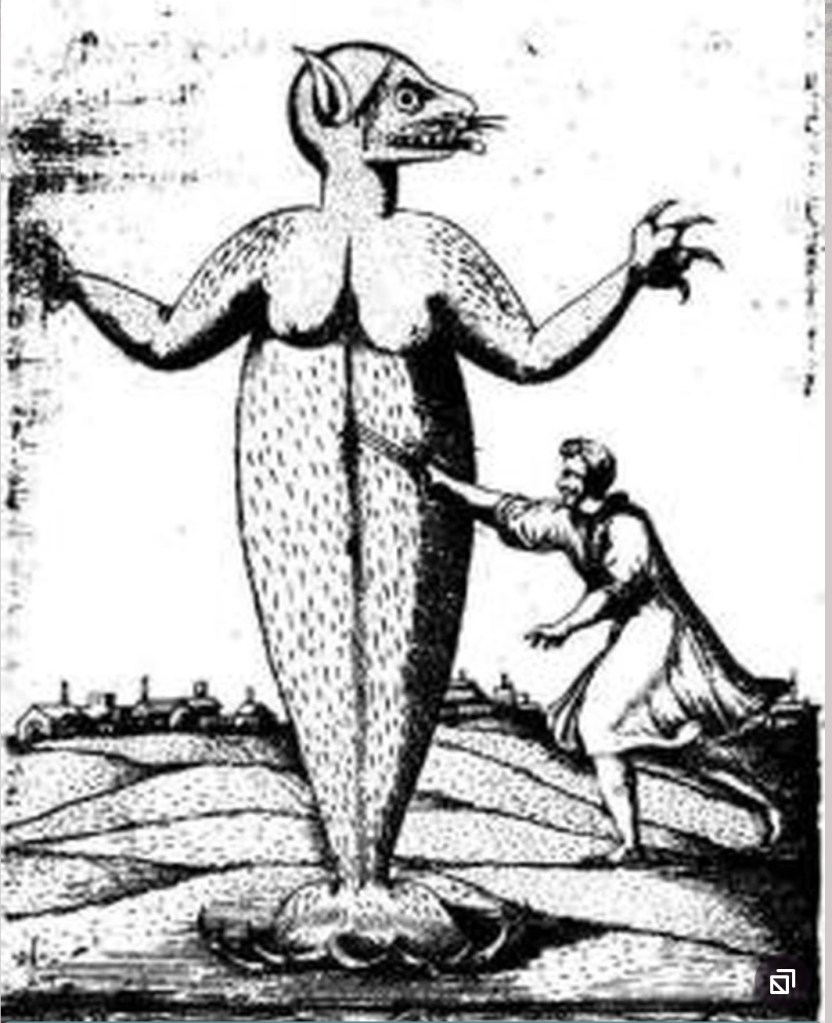
The Sea Lion as originally described in the 1500s from The John Carter Brown Library

For the second in a series of curious creatures once the cryptids of their time, we talk about the sea lion.

I can imagine a sea lion must have been quite a site if you had no knowledge or experience with one, I’d probably still want to pat one even then. But let’s take a look at one of it’s first sightings in Brazil in the 1500s…

In 1564, when the Portuguese had just arrived here, they found a monster on the beach? That’s right. It was where the city of São Vicente is today, on the coast of São Paulo. The story goes back to Pero de Magalhães Gândavo, one of our first historians. He says that, one night, the Indians pulled out of the sea a creature that measured more than 3 meters in length, full of fins and hair all over its body, “and on its snout it had very large silks like whiskers”. They named it ipupiara, or water demon in ancient Tupi.”

A text from that time tells a tale that goes a little like this;

Explorer Baltasar Ferreira killed this marine monster off the coast of São Vicente (present-day Santos in the state of São Paulo) in 1564. The monster is described as being 15 palms long, covered with hair, and with silky bristles like a mustache on its muzzle.

Today they say they still aren’t sure what the creature really was, but it is thought to be a lost sea lion that swam into their waters. A statue of the creature, which is thought to be what inspired the Creature from the Black Lagoon and The Shape of Water, still stands today…

Ipupiara Statue

Sources:

https://jcb.lunaimaging.com/luna/

https://contentenginellc.com/

‘Goat’s feet’ footprints left after sighting of strange creature, Ecuador – Nexus Newsfeed

Location. Tarqui, near Cuenca, Ecuador

Date: 1965 Time: night

A female peasant reported to authorities that at a local ‘abandoned house’ she was able to see on separate occasions ‘somebody or something’ taking refuge or hiding in the old, dilapidated structure.
— Read on nexusnewsfeed.com/article/unexplained/goat-s-feet-footprints-left-after-sighting-of-strange-creature-ecuador/

Bigfoot in the News… Return of the Sasquatch Wild Man

Vancouver, B. C.

Sasquatch men, remnants of a lost race of “wild men” who inhabited the rocky regions of British Columbia centuries ago, are reported roaming the province again.

After an absence of several months from the district of Harrison Mills, 50 miles east of Vancouver, the long, weird wolf- like howls are being heard again and two of the hairy monsters were reported seen in the Morris Valley on the Harrison river.

Residents in the district tell of seeing the two giants leaping and bounding out of the forest and striding across the duck-feeding ground, wallowing now and again in the bog and mire and long waving swamp grasses.

The strange men, it was reported, after emerging from the woods, came leaping down the jagged rocky hillside with the agility and lightness of mountain goats.

Snatches of their weird language floated on the breeze across the lake to the pioneer settlement at the foot of the hills.

The giants walked with an easy gait across the swamp flats and at the Morris Creek, in the shadow of Little Mystery Mountain, straddled a floating log, which they propelled with their long, hairy hands and huge feet across the sluggish glacial stream to the opposite side.

There they abandoned the log and climbed hand over hand up the almost perpendicular cliff at a point known as Gibraltar and disappeared into the wooded wilderness at the top of the ridge. They carried two large clubs and walked around a herd of cattle directly in their path.

The return of the giants to the legendary stronghold of the Sasquatch monsters recalls the narrow escape of an Indian at the same spot last March, a huge boulder narrowly missed his canoe while he was fishing and looking up he said he saw a huge and hairy monster stamping his feet and gesticulating wildly, The Indian escaped by cutting his fishing tackle and paddling away. The same Indian declared the Sasquatch twice have stolen salmon which he tied in a tree outside his house out of reach of the dogs The latest appearance of the monsters was peaceful. They avoided the trails usually used by the people of the valley and molested neither cattle nor human beings.

People who have reported seeing the giants on their rare appearances described them as “ferociou looking wild men, nine feet tall and covered from head to toe with thick black hair.”

The Waterbury Democrat (Waterbury, Conn.), October 31, 1935

I really enjoy these early sightings, they seem more sincere however fanciful. The rate bigfoot is currently reported being seen feels somehow less believable to me. So I almost feel more comfortable going into the past encounters than I do some present ones. And of course you also have the legendary cryptozoologists of the time as well. History has always been more my speed…

Is bigfoot real? Georgia has a lot of Sasquatch sightings | Columbus Ledger-Enquirer

Bigfoot is real in GA with over 140 sightings. The Southern Sasquatch would probably have something monogrammed & eat grits for breakfast.
— Read on www.ledger-enquirer.com/living/living-here-guide/outdoors/article289074644.html

The Wildman of New York…

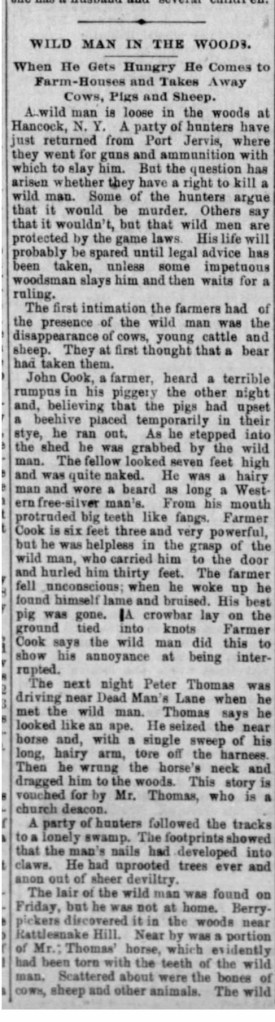
“A wild man is loose in the woods at Hancock, N. Y. A group of hunters have just returned from Port Jervis, where they went for guns and ammunition with which to slay him.

But the question has arisen whether they have a right to kill a wild man? Some of the hunters argue tnat it would be murder. Others say that it wouldn’t, but that wild men are protected by the game laws. His life will probably be spared until legal advice has been taken, unless some impetuous woodsman slays him and then waits for a ruling. The first intimation the farmers had of the presence of the wild man was the disappearance of cows, young cattle and sheep.

They at first thought that a bear had taken them. John Cook, a farmer, heard a terrible rumpus in his piggery the other night and, believing that the pigs had upset a beehive placed temporarily in their stye, he ran ont. As he stepped into the shed be was grabbed by the wild man. The fellow looked seven feet high and was quite naked. He was a hairy man.

From his mouth protruded big teeth like fangs. Farmer Cook is six feet three and very powerful, but he was helpless in the grasp of the wild man, who carried him to the door and hurled him thirty feet The farmer fell unconscious; when he woke up he found himself lame and bruised. His best pig was gone. crowbar lay on the ground tied into knots. Farmer Cook says the wild man did this to show his annoyance at being interrupted. The next night Peter Thomas was driving near Dead Man’s Lane when he met the wild man.

Thomas says he looked like an ape. He seized the near horse and, with a single sweep of his long, hairy arm, tore off the harness. Then he wrung the horse’s neck and dragged him to the woods. This story is vouched for by Mr. Thomas, who is a church deacon.

A party of hunters fallowed the tracks to a lonely swamp. The footprints showed that ths man’s nails had developed into claws. He had uprooted trees.The lair ot the wild man was found on Friday, but he was not at home. Berry pickers discovered it in the woods near Rattlesnake Hill.

Near by was a portion of Mr.; Thomas’ horse, which evidently had been torn with the teeth of the wild man. Scattered about were tbe bones of sheep and other animals. The wild man takes his meat raw. Some say the wild man is an escaped chimpanzee or gorilla, but a member of the New York Veterinarian Association who is boarding at Port Jervis says monkeys don’t eat meat.”

The Lancaster Daily

Lancaster Pennsylvania 1895