Consequent upon the information reported in our last Proceedings, another search was made in the wilds of Tasmania for evidence of the existence of this almost extinct Marsupial.
Thanks have been transmitted to the Tasmanian Board for its generosity in allowing M:. M. S. R. Sharland the opportunity of first hand knowledge of the position. Apparently
The expedition was fitted out by the Tasmanian Animals and Birds’ Protection Board, and as a guest, Mr. M S. R. Sharland accompanied it. A full account will be published in the Proceedings, from which it will be seen that new footprints were observed more than once indicating that more than one individual still survives in the locality searched.
Mr. Sharland upheld the traditions of the Society as the Tasmanian Board has renewed its invitation to their next research expedition.
It is a matter of regret that no animals were seen but this is mainly due to the nocturnal habits of the marsupial.”
This Information was printed in the Proceeding of the Royal Zoological Society of New South Wales for the year 1938
“Of Giant Apes and Snowmen IN the 1930’s, Ralph von Koenigswald, who discovered the first man-ape jaw in Java and some human remains to be described shortly, combed the Chinese drugstores of several Oriental cities, in search of fossil teeth. For centuries the Chinese have used the bones of fossil animals to cure their ills, in the belief that courage, strength, and virility come from the powdered remains of large, strong, and potent animals. Their cure for toothache is powdered teeth. Out of thousands of teeth, von Koenigswald found, in Hong Kong, six of particular interest. They are human-like in form, but six times as large, in volume, as those of living men. Between the stubs of the roots, gnawed by cave porcupines, he detected powdered yellow earth, which told him that the teeth had come from caves near the Yangtze gorges. He called the animal to whom the teeth had belonged Giganto-pithecus, the giant ape. For years some paleontologists believed that Gigantopithecus was an ancestor of man, but in the late 1950’s Chinese scientists found three jaws of this animal, which was an aberrant ape. It lived in the Pleistocene, too late to be our ancestor. An even more famous and fabulous animal is the Yeti, or Abominable Snowman. His tracks have been found in snow and mud in the Himalayas, and he has been reported as far north as Mongolia. Eyewitnesses have described him as tall, two-legged, tawny-coated, maned, big-muzzled, and big-toothed. Several expeditions to Nepal and Soviet Central Asia have failed to find this elusive animal, whose numerous tracks are so far unique. Even if it turns out to be a primate it is more likely to be a survival of Gigantopithecus than an Australopithecine.”
Have you ever encountered a tree so colorful and magnificent that it looks as though an artist’s painting just came to life?
No? Well, meet the Rainbow Eucalyptus tree. It’s a botanical wonder that adorns the natural world with its strikingly colorful bark.
Native to the Philippines, Indonesia, and Papua New Guinea, the Rainbow Eucalyptus is a true sight to behold . Its distinctive feature is its multi-colored bark, which changes hues as the tree sheds its outer layers. As the bark peels away, it reveals an array of colors—from bright green to blue, purple, orange, and maroon. This kaleidoscope effect is due to the varying stages of maturation and exposure of the bark to the elements.
While its appearance is captivating, the Rainbow Eucalyptus also plays a vital role in its native ecosystems. It thrives in tropical climates, often found near rivers and lakes. The tree can grow rapidly, reaching heights of over 200 feet. Its towering presence provides essential shade and habitat for various wildlife species and its leaves and bark are also used by natives for medicinal purposess.
If you’re like me, and your first thought was adding this living artwork to your backyard , there are a few things here to consider. This tree requires a warm, humid environment and ample space to grow. It’s not well-suited for colder climates, as it cannot withstand frost. Which means sadly I won’t be able to grow one. However, if you live somewhere with the right conditions, you can enjoy seeing this beauty in your own yard everyday. Seeds are easy to purchase online.
The Rainbow Eucalyptus is a reminder of nature’s own incredible beauty. As we continue to appreciate and protect these unique species, we ensure that future generations can marvel at their splendor too one day. Whether you’re a nature enthusiast or simply someone who appreciates the wonders of the natural world, the Rainbow Eucalyptus is sure to leave you an awe of its marvelous colors.
I wish I could enjoy having my cup of coffee each morning sitting in my favorite chair just staring at this tree.
Do you have a rainbow eucalyptus in your yard? Let me know, better yet, send me a photo, I’d love to see one!
The Wolf Moon, the first full moon of January which shined down on us last night, carries with it a mystique that’s been woven into folklore and legends across cultures.
In Native American traditions, it is named after the hungry howls of wolves heard during the frigid winter months. These howls were thought to signify the wolves’ yearning for the sustenance and warmth that the cold, barren landscape lacked. This moon marked a period of hardship and endurance for both the wolves and the people who lived alongside them.
In other cultures, the Wolf Moon is associated with transformation and inner strength. Legends speak of mythical creatures that were said to roam under this luminous moon, including werewolves, who would shift from human to wolf under its silvery light. The eerie glow of the Wolf Moon was thought to awaken a primal instinct within, urging individuals to connect with their wild, untamed nature.
There are also tales of spiritual awakenings and mystical encounters happening beneath the Wolf Moon. It’s a time believed to be ripe for introspection, releasing old habits, and setting intentions for the year ahead. Some legends even suggest that the Wolf Moon opens a portal to the realm of spirits, allowing for communication between the earthly and the otherworldly.
It’s fascinating how a single celestial event can inspire such a rich tapestry of stories and beliefs!
And sadly, I apologize that I wasn’t able to publish this last night due to a teeny hiking injury, but, better late than never! 🌕🐺✨
This is hair ice, it’s a rare type of ice formation where the presence of a type of fungus in rotting wood produces thin strands of ice which can resemble hair or cotton candy.
One of the first records of this ice was recorded by Alfred Wegener (who also discovered the continental drift) in 1918. He observed a strange ice forming only on wet dead wood and a theorized that a specific fungi must be the catalyst for the smooth, silky hairs of ice.
Hair ice forms on humid winter nights when the temperature is just below freezing. It’s most likely to form on dead alder branches.
Hair ice resembles hair or cotton candy. Hair ice is also known as frost flowers, frost beard, or ice wool. A fungus called Exidiopsis effusa is responsible for hair ice. The fungus produces thin threads of mycelium on branches, and hair ice grows on those branches.
Hair ice is not poisonous to touch, but it is also not edible. It’s a very rare occurrence, so if you’re lucky enough to see some on your morning walks too, please take some nice photos, and if you have time send one along to me, I’d love see and share them!
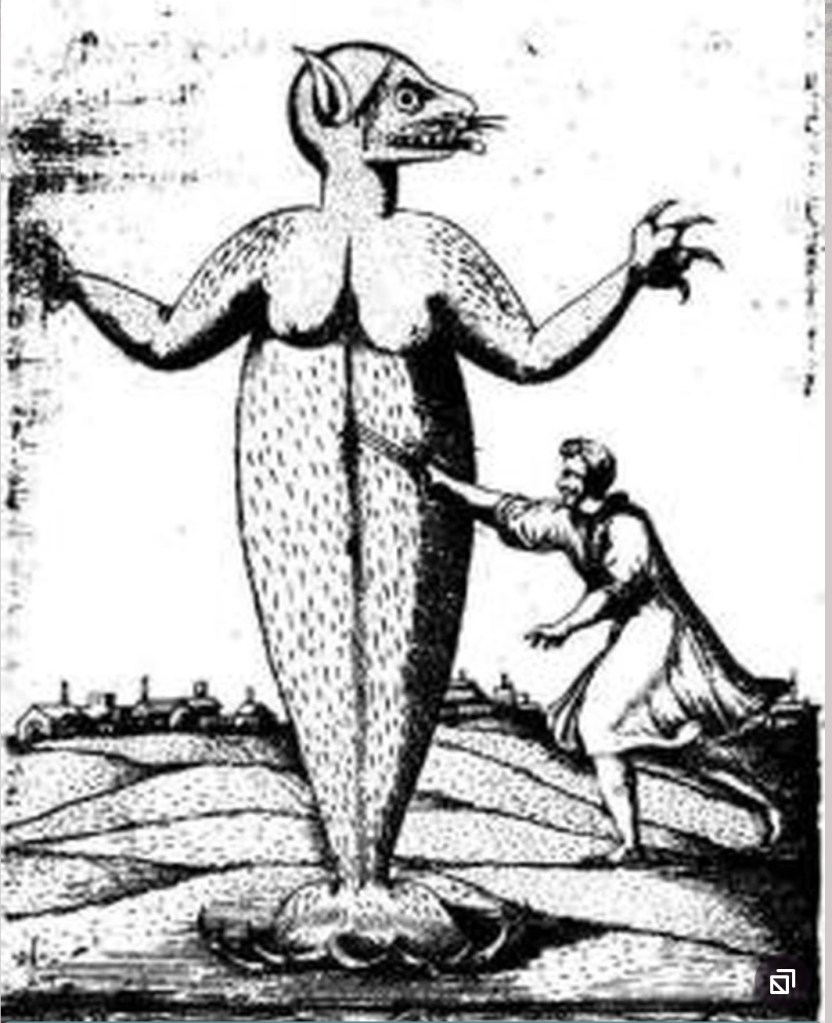
The Sea Lion as originally described in the 1500s from The John Carter Brown Library
For the second in a series of curious creatures once the cryptids of their time, we talk about the sea lion.
I can imagine a sea lion must have been quite a site if you had no knowledge or experience with one, I’d probably still want to pat one even then. But let’s take a look at one of it’s first sightings in Brazil in the 1500s…
In 1564, when the Portuguese had just arrived here, they found a monster on the beach? That’s right. It was where the city of São Vicente is today, on the coast of São Paulo. The story goes back to Pero de Magalhães Gândavo, one of our first historians. He says that, one night, the Indians pulled out of the sea a creature that measured more than 3 meters in length, full of fins and hair all over its body, “and on its snout it had very large silks like whiskers”. They named it ipupiara, or water demon in ancient Tupi.”
A text from that time tells a tale that goes a little like this;
Explorer Baltasar Ferreira killed this marine monster off the coast of São Vicente (present-day Santos in the state of São Paulo) in 1564. The monster is described as being 15 palms long, covered with hair, and with silky bristles like a mustache on its muzzle.
Today they say they still aren’t sure what the creature really was, but it is thought to be a lost sea lion that swam into their waters. A statue of the creature, which is thought to be what inspired the Creature from the Black Lagoon and The Shape of Water, still stands today…
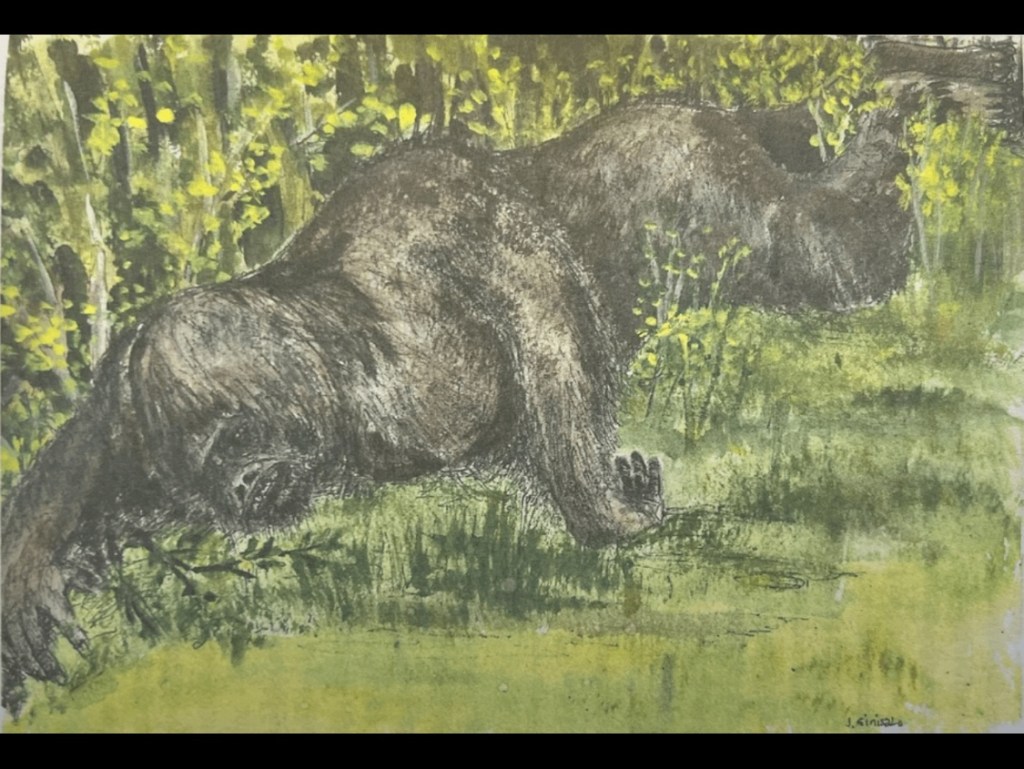
“This is my favorite piece of bigfoot art ever. It shows the story of a teen from Manitoba who claims that in 1941 he shot a sasquatch after mistaking it for a moose. At the time he was worried it was a human, so he kept quiet for decades. From the book “Strange Creatures Seldom Seen” “
This was posted on http://r/bigfoot below is from the BFRO report on this encounter. The BFRO investigator was able to go and interview this witness.
If anyone knows the artist of this painting please let me know so I may credit them.
It happened the first week of November, 1941, 62 years ago, when Peter was 17 years old. He’d gone hunting for moose with two friends around Basket Lake, a small lake about 15 miles west of Gypsumville, the town near where Peter grew up and has always lived. The two friends hunted the east side of Basket Lake; Peter wanted to go to the west side, which he knew was good for moose and elk. There was patchy snow on the ground and Peter found ambling moose tracks criss-crossing the area, indicating feeding animals.
The spotty snow made tracking difficult but he moved ahead: “…Sure enough, I did see one in the willows feeding with its head down, and it was a cow moose – no calf, I didn’t see a calf, and no horns, so I knew it was a cow. At that time the bulls still have their horns. But, in 1941 yet before the major fires, there were bush and willows so thick that you couldn’t believe it. So you had to shoot through willows, there’s not… you didn’t always have an open shot, so… take a chance. So I did shoot, because I knew… take one or two steps and… [It would be gone].”
And… I looked in the willows… again, and I could see all this hair, so I thought to myself ‘Well, I’ll slow you up,’ and I took a good aim and I fired. It disappeared… looked like I got it, so I walked up to it slowly… It wasn’t far, 45 yards, only – ‘cause that’s about as far as you could see in that stuff – if it was that far. But I took my time, because when you approach a big game animal you have to approach carefully. You carry your gun across your chest with your hand on the breach, ready to fire. If it wants to jump you, you have one good shot, point blank. Don’t raise the gun to your shoulder, just turn it and pull the trigger. That’s the last chance you got. Because a big game animal, he gets you, you’ve had it.