“In the 1990s, a strange creature emerged from the Brazilian Amazon Basin. Known as the Holadeira, or “sawtooth dolphin,” this cryptid was reportedly spotted by local and named the Holadeira and it even captured the attention of adventurers like Jeremy Wade.
Wade reportedly first saw the animal in 1994 about 100′ away from his boat while fishing. With its notched dorsal fin and elusive nature, some believe it was a unique species, while others think it might have been an injured Amazon river dolphin.
Wade, after witnessing it again and being able to photograph it on his second expedition out there, confirmed it was a dolphin, perhaps mutilated by fisherman…
I was reminded of this little legend on Reddit , if you’d like to keep up with the conversation on it over there here is the link…
Consequent upon the information reported in our last Proceedings, another search was made in the wilds of Tasmania for evidence of the existence of this almost extinct Marsupial.
Thanks have been transmitted to the Tasmanian Board for its generosity in allowing M:. M. S. R. Sharland the opportunity of first hand knowledge of the position. Apparently
The expedition was fitted out by the Tasmanian Animals and Birds’ Protection Board, and as a guest, Mr. M S. R. Sharland accompanied it. A full account will be published in the Proceedings, from which it will be seen that new footprints were observed more than once indicating that more than one individual still survives in the locality searched.
Mr. Sharland upheld the traditions of the Society as the Tasmanian Board has renewed its invitation to their next research expedition.
It is a matter of regret that no animals were seen but this is mainly due to the nocturnal habits of the marsupial.”
This Information was printed in the Proceeding of the Royal Zoological Society of New South Wales for the year 1938
“Of Giant Apes and Snowmen IN the 1930’s, Ralph von Koenigswald, who discovered the first man-ape jaw in Java and some human remains to be described shortly, combed the Chinese drugstores of several Oriental cities, in search of fossil teeth. For centuries the Chinese have used the bones of fossil animals to cure their ills, in the belief that courage, strength, and virility come from the powdered remains of large, strong, and potent animals. Their cure for toothache is powdered teeth. Out of thousands of teeth, von Koenigswald found, in Hong Kong, six of particular interest. They are human-like in form, but six times as large, in volume, as those of living men. Between the stubs of the roots, gnawed by cave porcupines, he detected powdered yellow earth, which told him that the teeth had come from caves near the Yangtze gorges. He called the animal to whom the teeth had belonged Giganto-pithecus, the giant ape. For years some paleontologists believed that Gigantopithecus was an ancestor of man, but in the late 1950’s Chinese scientists found three jaws of this animal, which was an aberrant ape. It lived in the Pleistocene, too late to be our ancestor. An even more famous and fabulous animal is the Yeti, or Abominable Snowman. His tracks have been found in snow and mud in the Himalayas, and he has been reported as far north as Mongolia. Eyewitnesses have described him as tall, two-legged, tawny-coated, maned, big-muzzled, and big-toothed. Several expeditions to Nepal and Soviet Central Asia have failed to find this elusive animal, whose numerous tracks are so far unique. Even if it turns out to be a primate it is more likely to be a survival of Gigantopithecus than an Australopithecine.”
The Wolf Moon, the first full moon of January which shined down on us last night, carries with it a mystique that’s been woven into folklore and legends across cultures.
In Native American traditions, it is named after the hungry howls of wolves heard during the frigid winter months. These howls were thought to signify the wolves’ yearning for the sustenance and warmth that the cold, barren landscape lacked. This moon marked a period of hardship and endurance for both the wolves and the people who lived alongside them.
In other cultures, the Wolf Moon is associated with transformation and inner strength. Legends speak of mythical creatures that were said to roam under this luminous moon, including werewolves, who would shift from human to wolf under its silvery light. The eerie glow of the Wolf Moon was thought to awaken a primal instinct within, urging individuals to connect with their wild, untamed nature.
There are also tales of spiritual awakenings and mystical encounters happening beneath the Wolf Moon. It’s a time believed to be ripe for introspection, releasing old habits, and setting intentions for the year ahead. Some legends even suggest that the Wolf Moon opens a portal to the realm of spirits, allowing for communication between the earthly and the otherworldly.
It’s fascinating how a single celestial event can inspire such a rich tapestry of stories and beliefs!
And sadly, I apologize that I wasn’t able to publish this last night due to a teeny hiking injury, but, better late than never! 🌕🐺✨
“In or round 1557, Jean Lerius and two other members of the company were trekking through a forest in the interior of Brazil with some local Tupinamba Indian guides but armed only with swords or bows and arrows when, while passing through a deep valley there, they abruptly encountered at a distance of only thirty paces or so a very large reptilian creature of extremely distinctive appearance, squatting on top of a hill in the heat of noon, with one of its forefeet raised. Lerius described it as a lizard bigger than the body of a man, measuring 5-6 ft long, yet its most eyecatching feature was not its size but rather its extraordinary tegument. For according to Lerius, this unfamiliar animal was entirely covered in rough white scales that resembled oyster shells (and presumably, therefore, were opalescent, or nacreous, i.e. resembling mother of pearl?”
It must be amazing to have possibly been the first learned human to see a creature like this. The very roots of cryptozoology, to find undiscovered creatures such as this. I feel like people believe it’s just about filming a weekend stake out at a bigfoot hotspot. And as fun as that is, don’t forget to look around the rest of the forest as you may be the next person to discover something new.
Looking for bigfoot evidence is important to me, as you probably know, but learning the fascinating historical tales of every creature’s first appearance to man is wonderful and fascinating…
TGIF everyone, be safe in the forest this weekend…
And follow along with the Shuker Nature’s blog if you get a chance, link is above….
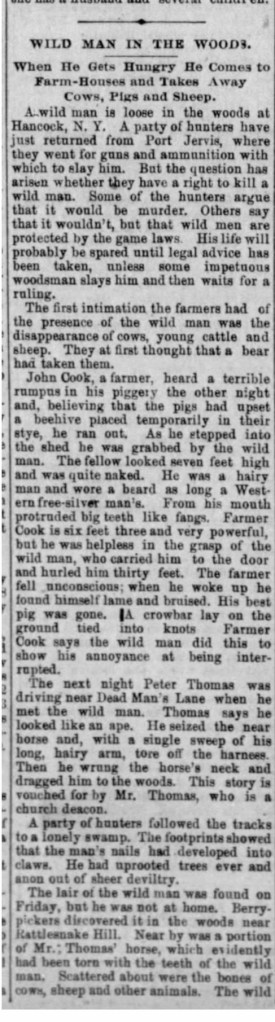
“A wild man is loose in the woods at Hancock, N. Y. A group of hunters have just returned from Port Jervis, where they went for guns and ammunition with which to slay him.
But the question has arisen whether they have a right to kill a wild man? Some of the hunters argue tnat it would be murder. Others say that it wouldn’t, but that wild men are protected by the game laws. His life will probably be spared until legal advice has been taken, unless some impetuous woodsman slays him and then waits for a ruling. The first intimation the farmers had of the presence of the wild man was the disappearance of cows, young cattle and sheep.
They at first thought that a bear had taken them. John Cook, a farmer, heard a terrible rumpus in his piggery the other night and, believing that the pigs had upset a beehive placed temporarily in their stye, he ran ont. As he stepped into the shed be was grabbed by the wild man. The fellow looked seven feet high and was quite naked. He was a hairy man.
From his mouth protruded big teeth like fangs. Farmer Cook is six feet three and very powerful, but he was helpless in the grasp of the wild man, who carried him to the door and hurled him thirty feet The farmer fell unconscious; when he woke up he found himself lame and bruised. His best pig was gone. crowbar lay on the ground tied into knots. Farmer Cook says the wild man did this to show his annoyance at being interrupted. The next night Peter Thomas was driving near Dead Man’s Lane when he met the wild man.
Thomas says he looked like an ape. He seized the near horse and, with a single sweep of his long, hairy arm, tore off the harness. Then he wrung the horse’s neck and dragged him to the woods. This story is vouched for by Mr. Thomas, who is a church deacon.
A party of hunters fallowed the tracks to a lonely swamp. The footprints showed that ths man’s nails had developed into claws. He had uprooted trees.The lair ot the wild man was found on Friday, but he was not at home. Berry pickers discovered it in the woods near Rattlesnake Hill.
Near by was a portion of Mr.; Thomas’ horse, which evidently had been torn with the teeth of the wild man. Scattered about were tbe bones of sheep and other animals. The wild man takes his meat raw. Some say the wild man is an escaped chimpanzee or gorilla, but a member of the New York Veterinarian Association who is boarding at Port Jervis says monkeys don’t eat meat.”
In 1673 French explorers going down the Mississippi River they noticed a painting on the rocks as they went by, in father Jacques Marquette’s journal he wrote the following;
“…while skirting some rocks, which by their height and length inspired awe, we saw upon one of them two painted monsters which at first made us afraid, and upon which the boldest savages dare not long rest their eyes…they are as large as a calf; they have horns on their heads like those of a deer, a horrible look, red eyes, a beard like a tiger’s, a face somewhat like a man’s, a body covered with scales, and so long a tail that it winds all around the body, passing above the head and going back between the legs, ending in a fish’s tail…”
Quarrying destroyed the original art we now know as being the Piasa Bird in 1860. Renditions attempted to recreate the artwork in 1924, 1950, and 1983, all of which were also destroyed because of development
The Piasa Bird was a creature that allegedly lived in the steep cliffs along the Mississippi River.
According to Native American myths. The Piasa was quite different from the Thunderbird as it was depicted as a flying dragon in ancient paintings dating back as far as 1200 CE.
“Many years ago a huge and fearsome creature began to carry off members of that tribe of Indians called the Illinois. Whole villages were depopulated. One night Ouatoga, a brave chief of this tribe, had a dream. In this dream the Great Spirit gave him a plan by which he could kill the man-eating creature.
When Ouatoga’s warriors eventually ambushed and killed the Piasa, they carved its image into a cliff face as a memorial.
According to legends, the Piasa Bird feasted on human flesh, but not fresh flesh. Rather, it circled around when Native American warriors battled enemy tribes. When the fighting ended, the Piasa Bird would swoop down to dine on the bodies of the fallen warriors.
McARTHUR, Ohio A man who has been searching for the legendary ‘ Bigfoot ‘ in southern Ohio says he has found new evidence that several of the elusive creatures may be living in the area.
Robert Gardnier of Columbus, Ohio, said he and several other hunters went into the Wayne National Forest west of McArthur recently and found footprints measuring 17 ? inches long and 9 inches wide.
Gardiner, who described the creatures as being ‘very shy,’ said he and his hunting party were surrounded by the creatures at one time.
‘We had been to this deserted A-frame … and were looking in this ravine for tracks and didn’t find anything,’ said Gardiner. ‘Later on … we came back to the A-frame and there were big tracks. These had to be made within an hour before we got there.’
He said the hunters went into the ravine where the visibility is limited because of dense woods, brush and brambles.
‘We were looking at a specific sign on a tree,’ he said. ‘We found something on a tree. I’m not going to divulge what it is, but we were checking it out and we heard one bark.
‘They have a barking-type growl like a chimpanzee or like a gorilla,’ he said. ‘We listened and then we heard one behind us, and what these two things were doing was communicating back and forth. They couldn’t have been over 25 or 30 yards away from us.
‘One was between us and the A-frame and the other was on the other side of us,’ he said.
Gaadiner said he feels the creatures are only passing through the area heading for mountains in the southern part of the United States. He said one may have been injured and that is why they are staying in the McArthur area for so long.
‘I’ve told everybody to quit shooting at these things,’ Gardiner said. ‘If you come across one, he won’t bother you. He’s just curious.’
Many hunters have tried to find the creature, also called Sasquatch , which is about as elusive as the Himalayan Yeti _ the ‘Abominable Snowman’ _ and supposedly comes from the Pacific Northwest.
Throughout the summer, Sasquatch -like creatures have been sighted and reported in southern and central Ohio.
Bigfoot reportedly was first sighted in Ohio near McArthur Aug. 24. Larry E. Cottrill said he found three Sasquatch -like animals near his home, shot at them and may have wounded one in the shoulder. Cottrill has since moved away.