Sasquatch men, remnants of a lost race of “wild men” who inhabited the rocky regions of British Columbia centuries ago, are reported roaming the province again.
After an absence of several months from the district of Harrison Mills, 50 miles east of Vancouver, the long, weird wolf- like howls are being heard again and two of the hairy monsters were reported seen in the Morris Valley on the Harrison river.
Residents in the district tell of seeing the two giants leaping and bounding out of the forest and striding across the duck-feeding ground, wallowing now and again in the bog and mire and long waving swamp grasses.
The strange men, it was reported, after emerging from the woods, came leaping down the jagged rocky hillside with the agility and lightness of mountain goats.
Snatches of their weird language floated on the breeze across the lake to the pioneer settlement at the foot of the hills.
The giants walked with an easy gait across the swamp flats and at the Morris Creek, in the shadow of Little Mystery Mountain, straddled a floating log, which they propelled with their long, hairy hands and huge feet across the sluggish glacial stream to the opposite side.
There they abandoned the log and climbed hand over hand up the almost perpendicular cliff at a point known as Gibraltar and disappeared into the wooded wilderness at the top of the ridge. They carried two large clubs and walked around a herd of cattle directly in their path.
The return of the giants to the legendary stronghold of the Sasquatch monsters recalls the narrow escape of an Indian at the same spot last March, a huge boulder narrowly missed his canoe while he was fishing and looking up he said he saw a huge and hairy monster stamping his feet and gesticulating wildly, The Indian escaped by cutting his fishing tackle and paddling away. The same Indian declared the Sasquatch twice have stolen salmon which he tied in a tree outside his house out of reach of the dogs The latest appearance of the monsters was peaceful. They avoided the trails usually used by the people of the valley and molested neither cattle nor human beings.
People who have reported seeing the giants on their rare appearances described them as “ferociou looking wild men, nine feet tall and covered from head to toe with thick black hair.”
The Waterbury Democrat (Waterbury, Conn.), October 31, 1935
I really enjoy these early sightings, they seem more sincere however fanciful. The rate bigfoot is currently reported being seen feels somehow less believable to me. So I almost feel more comfortable going into the past encounters than I do some present ones. And of course you also have the legendary cryptozoologists of the time as well. History has always been more my speed…
“The new research began after Javan resident and conservationist Ripi Yanur Fajar reported seeing a big cat jump between a road and a plantation near the village of Cipeundeuy in the forest of South Sukabumi in August 2019. Researchers visited the site nine days after the alleged sighting and found a hair on a nearby fence, along with potential tiger footprints and claw marks.“
The new research began after Javan resident and conservationist Ripi Yanur Fajar reported seeing a big cat jump between a road and a plantation near the village of Cipeundeuy in the forest of South Sukabumi in August 2019. Researchers visited the site nine days after the alleged sighting and found a hair on a nearby fence, along with potential tiger footprints and claw marks.
— Read on nexusnewsfeed.com/article/climate-ecology/is-the-javan-tiger-back-from-extinction-new-study-ignites-controversy/
The Javan tigerwas anative to theIndonesian island ofJava. It was one of threetiger populations that lived on the Sunda Islands during thelast glacial period. The tiger’s naturalhabitat was decreasing continuously as more land were needed for agriculture. Since no evidence of a Javan tiger was found during several studies in the 1980s and 1990s, it was determined that it was extinct in 2008.
“In or round 1557, Jean Lerius and two other members of the company were trekking through a forest in the interior of Brazil with some local Tupinamba Indian guides but armed only with swords or bows and arrows when, while passing through a deep valley there, they abruptly encountered at a distance of only thirty paces or so a very large reptilian creature of extremely distinctive appearance, squatting on top of a hill in the heat of noon, with one of its forefeet raised. Lerius described it as a lizard bigger than the body of a man, measuring 5-6 ft long, yet its most eyecatching feature was not its size but rather its extraordinary tegument. For according to Lerius, this unfamiliar animal was entirely covered in rough white scales that resembled oyster shells (and presumably, therefore, were opalescent, or nacreous, i.e. resembling mother of pearl?”
It must be amazing to have possibly been the first learned human to see a creature like this. The very roots of cryptozoology, to find undiscovered creatures such as this. I feel like people believe it’s just about filming a weekend stake out at a bigfoot hotspot. And as fun as that is, don’t forget to look around the rest of the forest as you may be the next person to discover something new.
Looking for bigfoot evidence is important to me, as you probably know, but learning the fascinating historical tales of every creature’s first appearance to man is wonderful and fascinating…
TGIF everyone, be safe in the forest this weekend…
And follow along with the Shuker Nature’s blog if you get a chance, link is above….
I don’t know why we are all so attached to these creatures, but I do know for me that it’s bad enough man likely caused their extinction, but to also have their last photos and end come from a zoo looking like this zoo does just turns my stomach. Maybe, just maybe if we left them alone in the wild they would still be around. But now the last ones had to also suffer us putting them in this deplorable looking cage and most likely, like most of these old zoos of the time, not treated respectfully.
They must have been so scared, and anxious. I literally pray these creatures are alive just so their extinction was not there.
Rare photographs reveal the long-extinct marsupials in a more delicate light.
One image from a private collection, which Yahoo News has published with permission, shows two lounging side-by-side in the sun. The original photograph, which measures just 8.9cm x 8.9cm, was taken at Beaumaris Zoo in 1918.
It was quietly published in a journal for the first time just four years ago after it was purchased at auction in 2004, and other than a few tiger enthusiasts, few people have been aware of its existence. When it was shared to an online naturalist’s forum in June along with several other generally unknown photos taken in overseas zoos, they created a stir.
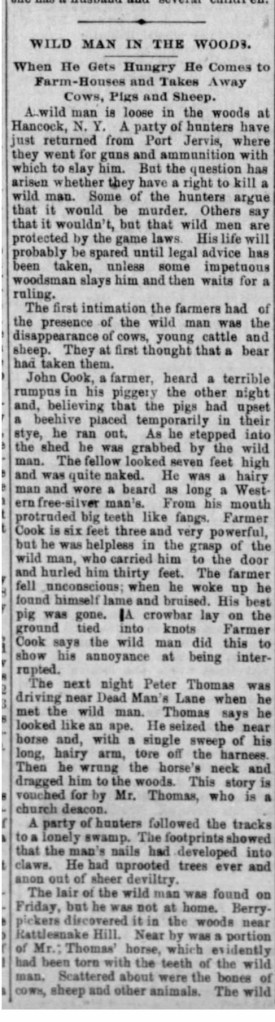
“A wild man is loose in the woods at Hancock, N. Y. A group of hunters have just returned from Port Jervis, where they went for guns and ammunition with which to slay him.
But the question has arisen whether they have a right to kill a wild man? Some of the hunters argue tnat it would be murder. Others say that it wouldn’t, but that wild men are protected by the game laws. His life will probably be spared until legal advice has been taken, unless some impetuous woodsman slays him and then waits for a ruling. The first intimation the farmers had of the presence of the wild man was the disappearance of cows, young cattle and sheep.
They at first thought that a bear had taken them. John Cook, a farmer, heard a terrible rumpus in his piggery the other night and, believing that the pigs had upset a beehive placed temporarily in their stye, he ran ont. As he stepped into the shed be was grabbed by the wild man. The fellow looked seven feet high and was quite naked. He was a hairy man.
From his mouth protruded big teeth like fangs. Farmer Cook is six feet three and very powerful, but he was helpless in the grasp of the wild man, who carried him to the door and hurled him thirty feet The farmer fell unconscious; when he woke up he found himself lame and bruised. His best pig was gone. crowbar lay on the ground tied into knots. Farmer Cook says the wild man did this to show his annoyance at being interrupted. The next night Peter Thomas was driving near Dead Man’s Lane when he met the wild man.
Thomas says he looked like an ape. He seized the near horse and, with a single sweep of his long, hairy arm, tore off the harness. Then he wrung the horse’s neck and dragged him to the woods. This story is vouched for by Mr. Thomas, who is a church deacon.
A party of hunters fallowed the tracks to a lonely swamp. The footprints showed that ths man’s nails had developed into claws. He had uprooted trees.The lair ot the wild man was found on Friday, but he was not at home. Berry pickers discovered it in the woods near Rattlesnake Hill.
Near by was a portion of Mr.; Thomas’ horse, which evidently had been torn with the teeth of the wild man. Scattered about were tbe bones of sheep and other animals. The wild man takes his meat raw. Some say the wild man is an escaped chimpanzee or gorilla, but a member of the New York Veterinarian Association who is boarding at Port Jervis says monkeys don’t eat meat.”


 Sasysquatchgirl