“Of Giant Apes and Snowmen IN the 1930’s, Ralph von Koenigswald, who discovered the first man-ape jaw in Java and some human remains to be described shortly, combed the Chinese drugstores of several Oriental cities, in search of fossil teeth. For centuries the Chinese have used the bones of fossil animals to cure their ills, in the belief that courage, strength, and virility come from the powdered remains of large, strong, and potent animals. Their cure for toothache is powdered teeth. Out of thousands of teeth, von Koenigswald found, in Hong Kong, six of particular interest. They are human-like in form, but six times as large, in volume, as those of living men. Between the stubs of the roots, gnawed by cave porcupines, he detected powdered yellow earth, which told him that the teeth had come from caves near the Yangtze gorges. He called the animal to whom the teeth had belonged Giganto-pithecus, the giant ape. For years some paleontologists believed that Gigantopithecus was an ancestor of man, but in the late 1950’s Chinese scientists found three jaws of this animal, which was an aberrant ape. It lived in the Pleistocene, too late to be our ancestor. An even more famous and fabulous animal is the Yeti, or Abominable Snowman. His tracks have been found in snow and mud in the Himalayas, and he has been reported as far north as Mongolia. Eyewitnesses have described him as tall, two-legged, tawny-coated, maned, big-muzzled, and big-toothed. Several expeditions to Nepal and Soviet Central Asia have failed to find this elusive animal, whose numerous tracks are so far unique. Even if it turns out to be a primate it is more likely to be a survival of Gigantopithecus than an Australopithecine.”
“Baum, who was in the woods late in the afternoon with his stepfather to build the tree stand for future hunting use, said he immediately knew what he was seeing. Though it was late afternoon, it had been a bright, sunny day, he said.
In other words, the visibility was excellent in the area near Hanley and Woodville Roads, just east of I-71, especially with no leaves on the trees.”
The iconic museum, located alongside Highway 9 in Felton, has embodied Santa Cruz’s quirkiness for twenty years.
As Ruggs retires, the museum will retire alongside him.
“Well, anywhere from 30 to 70 people come in the door and, they’ll check everything out, and, I show them our local sighting map, and, they’re usually amazed to see how many sightings there have been in this area. I was amazed, too, because when I opened it, I didn’t expect that to happen,” Ruggs said.
Ruggs says he first saw Bigfoot when he was a kid.
“I looked upstream, and then when I look back towards the woods. Whoa, here’s this big hairy guy standing there looking at me. And we had eye contact for about the count of three. Then I heard my mother screaming. Mikey, where are you? So I thought, oh, jeez, I better get back,” Ruggs recalled.
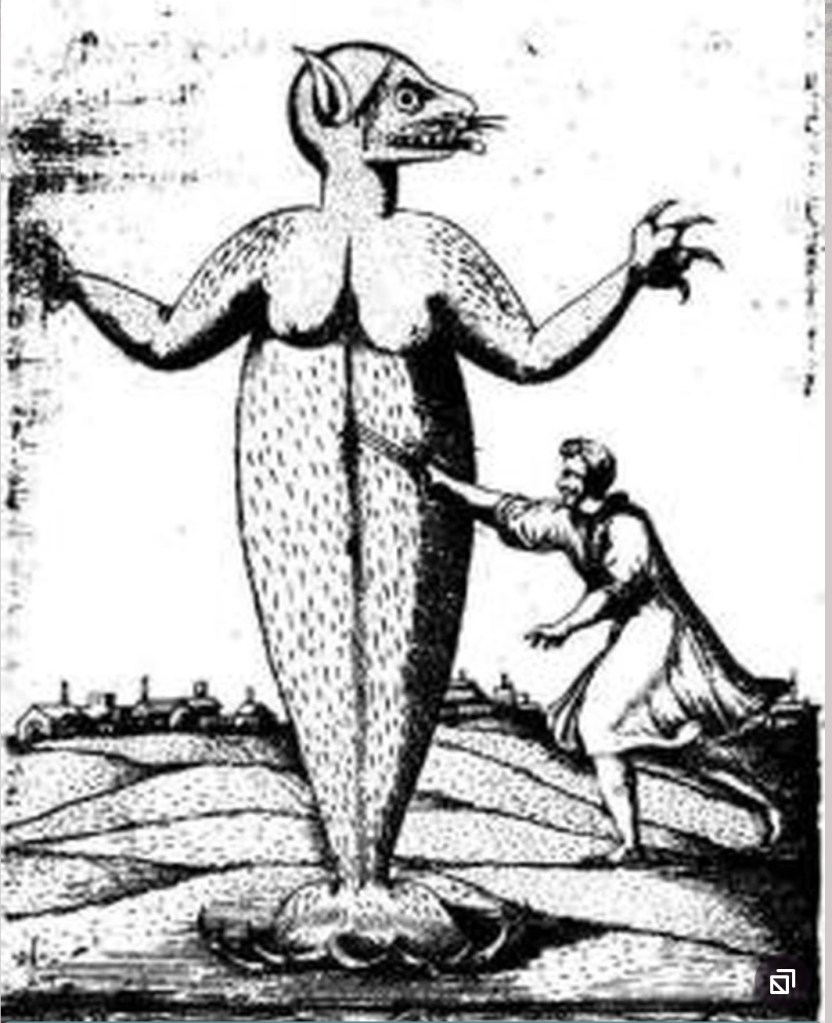
The Sea Lion as originally described in the 1500s from The John Carter Brown Library
For the second in a series of curious creatures once the cryptids of their time, we talk about the sea lion.
I can imagine a sea lion must have been quite a site if you had no knowledge or experience with one, I’d probably still want to pat one even then. But let’s take a look at one of it’s first sightings in Brazil in the 1500s…
In 1564, when the Portuguese had just arrived here, they found a monster on the beach? That’s right. It was where the city of São Vicente is today, on the coast of São Paulo. The story goes back to Pero de Magalhães Gândavo, one of our first historians. He says that, one night, the Indians pulled out of the sea a creature that measured more than 3 meters in length, full of fins and hair all over its body, “and on its snout it had very large silks like whiskers”. They named it ipupiara, or water demon in ancient Tupi.”
A text from that time tells a tale that goes a little like this;
Explorer Baltasar Ferreira killed this marine monster off the coast of São Vicente (present-day Santos in the state of São Paulo) in 1564. The monster is described as being 15 palms long, covered with hair, and with silky bristles like a mustache on its muzzle.
Today they say they still aren’t sure what the creature really was, but it is thought to be a lost sea lion that swam into their waters. A statue of the creature, which is thought to be what inspired the Creature from the Black Lagoon and The Shape of Water, still stands today…
We in the cryptozoology community post often about the beloved thylacine, but for me the part of its history I have a hard time coming to terms with is its last days at the zoo and the films which appear to be a dank miserable zoo environment.
But how was their care really? Who ran that zoo? Maybe if we know a little bit about that it may be easier to study the last of these amazing creatures.
It turns out that this zoo wasn’t as uncaring as the video made it seem by its age and quality.
Mary Robert with her thylacines
A women named Mary Roberts opened the Beaumaris Zoo on her property in Hobart in 1875.
Mary had no formal schooling in zoology, but she did have a passion for Tasmanian fauna. Mary began sharing her passion with the general public in 1895.
Her great love and care for the thylacine was well known. She became the first woman to successfully breed them in captivity. So loved by her they were, that she wrote a manual on the keeping, caring, and breeding of the thylacine.
She was accepted into the Zoological Society of London, where she began gaving lectures on the care of these amazing marsupials.
In 1921 Mary Roberts passed away and the zoo and its many inhabitants were offered to the Tasmanian government, who declined the offer sadly. Then they were cared for by a Scottish farmer who was a great nature enthusiast. The Beaumaris Zoo was eventually moved to a location in Queens.
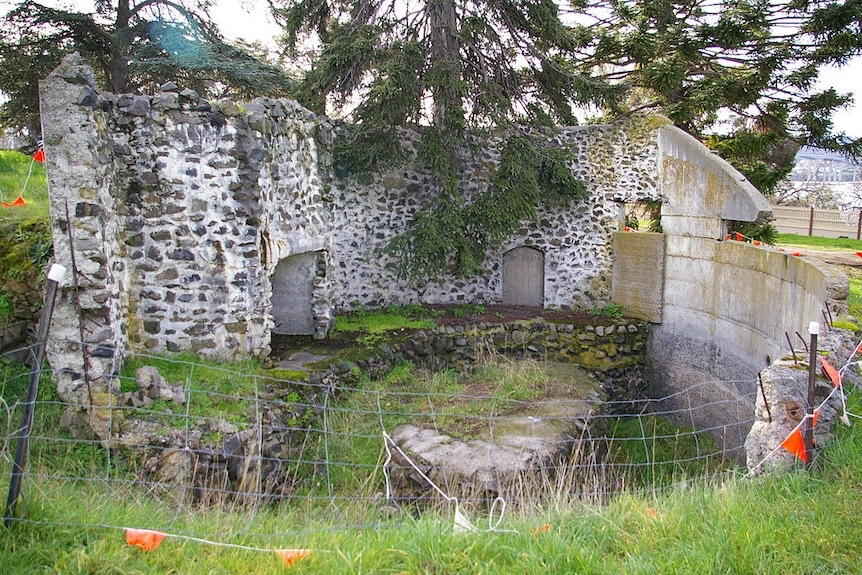
Sadly the last known living tiger died in 1936, the zoo itself closed a year later in 1937. There are only a few remains left of the zoo’s buildings where it stood last…
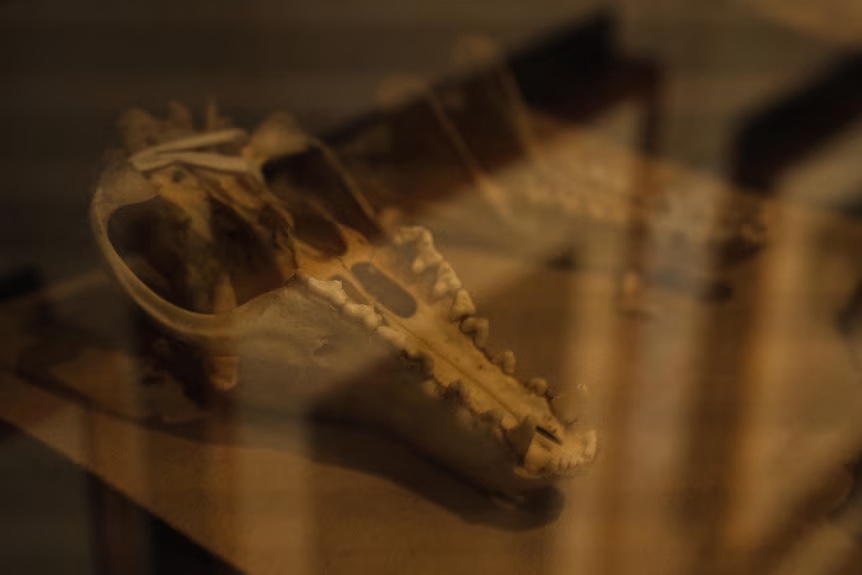
The skull of the last thylacine
The remains of the last thylacine were given to the Tasmanian Museum and Art Gallery, who being unaware they had the last specimen of its kind, did a traveling exhibit with them instead of working on proper storage and cataloguing.
But how does all this make you feel now? Is it better to see those videos knowing Mary Roberts truly cared for them and tried to educate everyone on their proper care?
The Tiger enclosure
For me personally it makes it a little better understanding their history with at least their time with her. I still question their care in their last days . They appear so skinny in the videos, and just knowing the last one died due a cold spell, because they weren’t put in the proper habitat that night just doesn’t help me.
I pray they had some affection along the way. And as much as I would love to see these elusive creatures alive, I don’t agree with the de-extinction plan for them.
Humans are doing a number on this planet causing extinction and near extinction of many of its species. So the idea that it would be a good thing to bring them back in a time we are killing off others just doesn’t make sense and seems highly unethical to me.
What are your thoughts on the de-extinction of the thylacine? Do you think this world can support and keep them alive now in its current state? Let me know.