Bergman and the Three Big Bears…

The Bergman Bear , is supposedly a giant bear native to Russia’s Kamchatka Peninsula.

This giant bear ended up intriguing Swedish zoologist Sten Bergman.

Bergman first brought attention to this elusive bear in the 1920s after examining a hide that was far larger than any known bear species. He described it as having short black fur and weighing between 450 and 2,500 pounds!

Bergman believed in the existence of this giant bear due to the physical evidence he encountered such as a massive paw prints measuring nearly 15 inches long and 10 inches wide. While no firsthand sightings have been recorded since the 1920s, local legends and rumors suggest that a few might still roam the remote regions of Siberia.

George M. Eberhart who wrote the book Mysterious Creatures: A Guide to Cryptozoology has said that if it existed, it is “likely extinct”…

But could it be possible that this bear is still roaming Siberia? I believe it is.

There are other unbelievably large bears roaming in that area, let’s look at the Kamchatka brown bear for instance. The Kamchatka brown bear is the biggest brown bear in Eurasia with a body length of 7.9 to 9.8 ft tall on its hind legs, and it weights up 1,430 lbs.

Kamchatka brown bears are generally not dangerous to humans. During a study on the animal, one researcher found only 1% of his 270 encounters ended in a human attack.

Then there is the Irkuiem bear otherwise known as the “god bear”.

The Irkuiem bear is considered a cryptid bear, also from Russia’s Kamchatka Peninsula. According to Fandom’s Encyclopedia of Cryptids, the descriptions of its enormous size and odd limb proportions led to the theory that it could be a short-faced bear, that would mean believing they weren’t actually extinct. Now it is believed to be a unique form of brown bear.

With one large known bear strolling around, would it be so impossible to believe that these currently labeled, “cryptid bears” could be out there as well?

Let me know what you think, have a great Sunday…

William T. Cox and the Fearsome Creatures of the Lumber Woods…

William T. Cox was the first State Forester and Commissioner of Conservation for Minnesota. He worked as a forester for the United States Forest Service. In 1929 Cox even traveled to Brazil to organize the Brazilian Forest Service. But what William T. Cox is most remembered for now is a brilliant field guide he wrote back in 1910 about imaginary creatures, or cryptids as we now know them today. 

Image from Cox’s obituary page.

This field guide, with illustrations by Coert du Bois titled Fearsome Creatures of the Lumber Woods, With a few Dessert and Mountain Beasts features fictional creatures loggers would make up in their time in the deep forests. Often to haze new lumberers with. 

Some of the amazing creatures featured in this book were the hodag, and the brilliant creature, the hugag. The Hugag is described as being similar to a moose with an extensive upper-lip, preventing it from grazing, and jointless legs preventing it from lying down. 

The hugag

But not all were completely fictional some were just embellished from strange creatures actually reported such as the Hyampom Hog Bear and the Snoligoster.  Whether you’re reading about the fictional or the embellished critters here, it makes for a great read. I thoroughly enjoyed reading it again this weekend and definitely recommend it for the lovers of cryptozoology.

Have an awesome Sunday everyone!

Fearsome Creatures of the Lumber Woods

Stalking the Mysterious Skunk Ape of Florida’s Swamplands | OutdoorHub

Stalking the Mysterious Skunk Ape of Florida’s Swamplands | OutdoorHub
— Read on www.outdoorhub.com/stories/2025/03/07/stalking-mysterious-skunk-ape-floridas-swamplands/

The Holadeira Mystery

“In the 1990s, a strange creature emerged from the Brazilian Amazon Basin. Known as the Holadeira, or “sawtooth dolphin,” this cryptid was reportedly spotted by local and named the Holadeira and it even captured the attention of adventurers like Jeremy Wade.

Wade reportedly first saw the animal in 1994 about 100′ away from his boat while fishing. With its notched dorsal fin and elusive nature, some believe it was a unique species, while others think it might have been an injured Amazon river dolphin.  

Wade, after witnessing it again and being able to photograph it on his second expedition out there, confirmed it was a dolphin, perhaps mutilated by fisherman…

I was reminded of this little legend on Reddit , if you’d like to keep up with the conversation on it over there here is the link…


https://www.reddit.com/r/Cryptozoology/s/jigVL5uWnA

Have an awesome Sunday and keep your eyes open you never no what you mind find out there wandering the forests and the seas…

Bigfoot or a Neanderthal…

In the late 1960s, a Soviet historian became fascinated with reports of a giant ape-like beast roaming the mountains of Central Asia. His obsession led him to develop an elaborate theory that these sightings were not of a mysterious cryptid, but of surviving Neanderthals who had endured since the last ice age.

Born in 1905, Boris Porshnev was a Soviet historian who dedicated much of his career

to studying mainstream academic topics, like popular uprisings in 17th-century France and the Thirty Years’ War. However, his scholarly pursuits were later peppered with an unorthodox interest in cryptozoology, especially the strange reports of the so-called Almas.

For centuries, reports of the Almas have emerged from people living within the mountain system of Central and East Asia, including Mongolia, the Altai and Tian Shan Mountains, Xinjiang, Gansu and Qinghai in China, and the Tuva Republic in Siberia.

As reports continued to surface, Porshnev secured approval from the Soviet Academy of Sciences in the 1950s to formally investigate the Almas. In 1958, he led an expedition to the Pamirs of Tajikistan, accompanied by a team of folklore experts, geologists, and botanists. After collecting a load of anecdotal reports about local sightings, the commission compiled a 400-page report on the topic, concluding that the Almas was most likely real and residing in the region between the Tian Shan, Pamir, and Mongolia. 

After the expedition, Porshnev began to suggest that the Almas were, in fact, a living Neanderthal. He had flirted with the idea in previous publications, but it was most explicitly laid out in his 1974 book called L’Homme de Néanderthal est toujours vivant (French for Neanderthal Man is Still Alive), co-authored with explorer and prominent cryptozoologist Bernard Heuvelmans.

“One must say that Porshnev and I were both quite convinced of the existence of wild hairy men in the broadest and loosest sense,” Heuvelmans wrote in the intro to Porshnev’s other book, The Struggle for Troglodytes.

“However, there was a point on which we never managed to agree: I saw the Himalayan snowman as an anthropoid ape while Porshnev saw an actual human, more specifically a Neanderthal man survivor from the recent Pleistocene,” he added. Fossilized remains of the extinct hominin species have been uncovered in this part of world.

You can read more from IFL Science’s article Here

But what do you think about his theory? I have always been on a line believing more that what ever this creature turns out to be, they have likely been here along. After all we know now thanks to more recent findings that several different types of hominids were existing side by side, might the infamous cryptid wandering out forests be one of them. I think yes. Man? Ape? Something in between most likely.

Maybe some day we’ll know for sure, hopefully in our lifetime…

Have a great day everyone and please I’d love to hear your thoughts…

Camper shares terrifying ‘Big Foot’ encounter miles away from Sasquatch-sighting hotspot | Daily Mail Online

A terrified camper claims he was left cowering in his tent after being woken up by the 15-foot sasquatch.
— Read on www.dailymail.co.uk/news/article-14473615/Camper-Big-Foot-encounter-Sasquatch-sighting-hotspot.html

Bigfoot sighting In Pennsylvania…

Pennsylvania man says that a during a recent hunting trip he was stalked by Sasquatch getting a close-up view of the creature’s face. The incident took place on February 19th on game lands near Penn State, where he goes to school. Identified as ‘M.K.,’ he was hunting for raccoons that evening when he suddenly heard an unnerving sound that he likened to someone striking a tree with a bat. Perturbed by the peculiar noise, he ventured further into the woods away from the thud while feeling as though something was following him. 

With a spotlight, he scanned the forest as he walked and briefly caught sight of “something large and upright.” As he was turning his light on during the conversation, he flashed upon the face of the creature that was standing about 40 yards away. He described him as looking like the recent film version of King Kong. He states it had a sharp nose, a grey-skinned face with similarly colored hair, and a rounded chin. 

He also noted that the creature’s arms and shoulders were massive. The sighting only lasted a few seconds before what he now believes to have been a Bigfoot vanished back into the woods…

The BFRO investigator who looked into the student’s stunning report deemed him “earnest and very credible.” 

You can read the entire article from Tim Binnall on Coast to Coast  below…

 I think for me the King Kong description has me a little suspicious, but what are your thoughts? Let me know…

TGIF everyone!

https://www.coasttocoastam.com/article/pennsylvania-hunter-reports-chilling-face-to-face-encounter-with-bigfoot/

Video: Trail of Bigfoot Tracks Found in Snowy Maine Forest? | NewsRadio 1110 KFAB | Coast to Coast AM with George Noory

The BFRO are recognizing these prints as authentic bigfoot tracks. Some say they are deer tracks made to look larger from the snow.

Your thoughts?

An intriguing video from Maine shows a trail of sizeable prints found in a snowy forest and some suspect that the peculiar tracks could have been left behind by Bigfoot.
— Read on kfab.iheart.com/featured/coast-to-coast-am/content/2025-03-03-video-trail-of-bigfoot-tracks-found-in-snowy-maine-forest/

Thylacine in History…

Preservation of the Tasmanian Tiger…”

Consequent upon the information reported in our last Proceedings, another search was made in the wilds of Tasmania for evidence of the existence of this almost extinct Marsupial.

Thanks have been transmitted to the Tasmanian Board for its generosity in allowing M:. M. S. R. Sharland the opportunity of first hand knowledge of the position. Apparently

The expedition was fitted out by the Tasmanian Animals and Birds’ Protection Board, and as a guest, Mr. M S. R. Sharland accompanied it. A full account will be published in the Proceedings, from which it will be seen that new footprints were observed more than once indicating that more than one individual still survives in the locality searched.

Mr. Sharland upheld the traditions of the Society as the Tasmanian Board has renewed its invitation to their next research expedition.

It is a matter of regret that no animals were seen but this is mainly due to the nocturnal habits of the marsupial.”

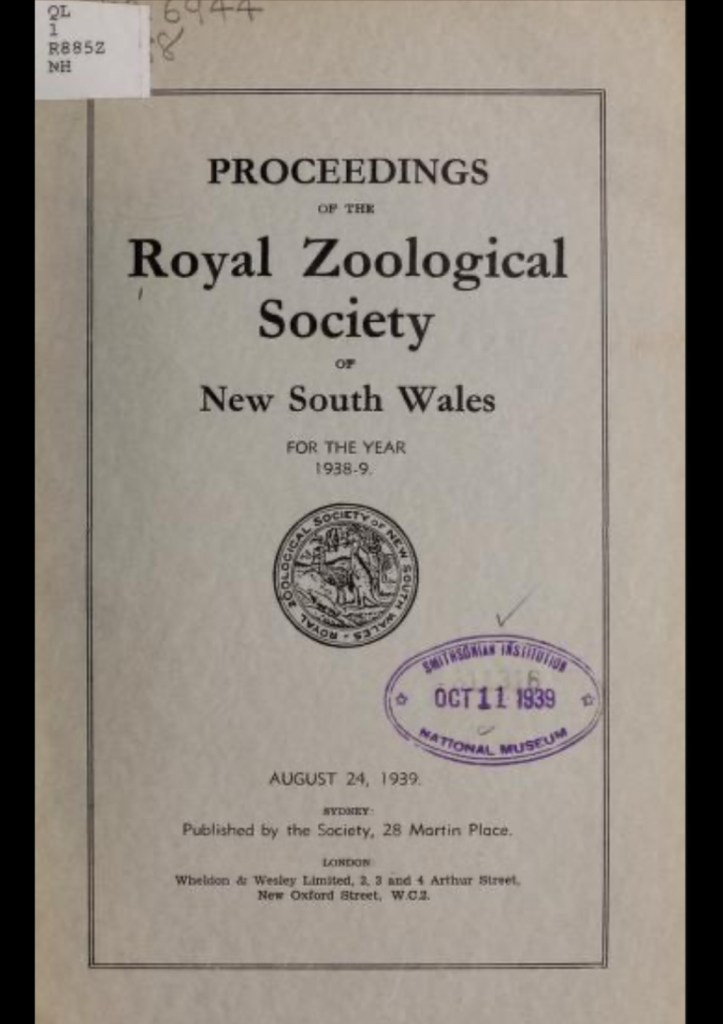
This Information was printed in the Proceeding of the Royal  Zoological Society of  New South Wales for the year 1938 

The mention of footprints makes me hold out hope…