Consequent upon the information reported in our last Proceedings, another search was made in the wilds of Tasmania for evidence of the existence of this almost extinct Marsupial.
Thanks have been transmitted to the Tasmanian Board for its generosity in allowing M:. M. S. R. Sharland the opportunity of first hand knowledge of the position. Apparently
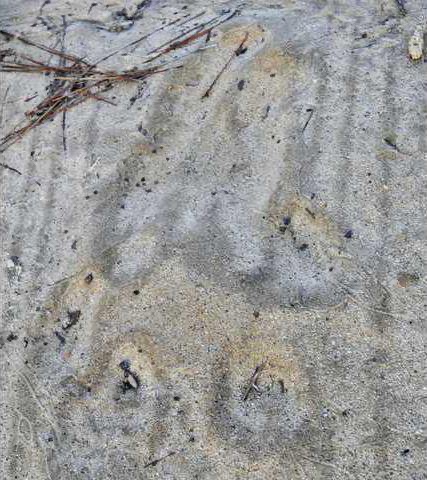
The expedition was fitted out by the Tasmanian Animals and Birds’ Protection Board, and as a guest, Mr. M S. R. Sharland accompanied it. A full account will be published in the Proceedings, from which it will be seen that new footprints were observed more than once indicating that more than one individual still survives in the locality searched.
Mr. Sharland upheld the traditions of the Society as the Tasmanian Board has renewed its invitation to their next research expedition.
It is a matter of regret that no animals were seen but this is mainly due to the nocturnal habits of the marsupial.”
This Information was printed in the Proceeding of the Royal Zoological Society of New South Wales for the year 1938
“Of Giant Apes and Snowmen IN the 1930’s, Ralph von Koenigswald, who discovered the first man-ape jaw in Java and some human remains to be described shortly, combed the Chinese drugstores of several Oriental cities, in search of fossil teeth. For centuries the Chinese have used the bones of fossil animals to cure their ills, in the belief that courage, strength, and virility come from the powdered remains of large, strong, and potent animals. Their cure for toothache is powdered teeth. Out of thousands of teeth, von Koenigswald found, in Hong Kong, six of particular interest. They are human-like in form, but six times as large, in volume, as those of living men. Between the stubs of the roots, gnawed by cave porcupines, he detected powdered yellow earth, which told him that the teeth had come from caves near the Yangtze gorges. He called the animal to whom the teeth had belonged Giganto-pithecus, the giant ape. For years some paleontologists believed that Gigantopithecus was an ancestor of man, but in the late 1950’s Chinese scientists found three jaws of this animal, which was an aberrant ape. It lived in the Pleistocene, too late to be our ancestor. An even more famous and fabulous animal is the Yeti, or Abominable Snowman. His tracks have been found in snow and mud in the Himalayas, and he has been reported as far north as Mongolia. Eyewitnesses have described him as tall, two-legged, tawny-coated, maned, big-muzzled, and big-toothed. Several expeditions to Nepal and Soviet Central Asia have failed to find this elusive animal, whose numerous tracks are so far unique. Even if it turns out to be a primate it is more likely to be a survival of Gigantopithecus than an Australopithecine.”
Have you ever encountered a tree so colorful and magnificent that it looks as though an artist’s painting just came to life?
No? Well, meet the Rainbow Eucalyptus tree. It’s a botanical wonder that adorns the natural world with its strikingly colorful bark.
Native to the Philippines, Indonesia, and Papua New Guinea, the Rainbow Eucalyptus is a true sight to behold . Its distinctive feature is its multi-colored bark, which changes hues as the tree sheds its outer layers. As the bark peels away, it reveals an array of colors—from bright green to blue, purple, orange, and maroon. This kaleidoscope effect is due to the varying stages of maturation and exposure of the bark to the elements.
While its appearance is captivating, the Rainbow Eucalyptus also plays a vital role in its native ecosystems. It thrives in tropical climates, often found near rivers and lakes. The tree can grow rapidly, reaching heights of over 200 feet. Its towering presence provides essential shade and habitat for various wildlife species and its leaves and bark are also used by natives for medicinal purposess.
If you’re like me, and your first thought was adding this living artwork to your backyard , there are a few things here to consider. This tree requires a warm, humid environment and ample space to grow. It’s not well-suited for colder climates, as it cannot withstand frost. Which means sadly I won’t be able to grow one. However, if you live somewhere with the right conditions, you can enjoy seeing this beauty in your own yard everyday. Seeds are easy to purchase online.
The Rainbow Eucalyptus is a reminder of nature’s own incredible beauty. As we continue to appreciate and protect these unique species, we ensure that future generations can marvel at their splendor too one day. Whether you’re a nature enthusiast or simply someone who appreciates the wonders of the natural world, the Rainbow Eucalyptus is sure to leave you an awe of its marvelous colors.
I wish I could enjoy having my cup of coffee each morning sitting in my favorite chair just staring at this tree.
Do you have a rainbow eucalyptus in your yard? Let me know, better yet, send me a photo, I’d love to see one!
The Wolf Moon, the first full moon of January which shined down on us last night, carries with it a mystique that’s been woven into folklore and legends across cultures.
In Native American traditions, it is named after the hungry howls of wolves heard during the frigid winter months. These howls were thought to signify the wolves’ yearning for the sustenance and warmth that the cold, barren landscape lacked. This moon marked a period of hardship and endurance for both the wolves and the people who lived alongside them.
In other cultures, the Wolf Moon is associated with transformation and inner strength. Legends speak of mythical creatures that were said to roam under this luminous moon, including werewolves, who would shift from human to wolf under its silvery light. The eerie glow of the Wolf Moon was thought to awaken a primal instinct within, urging individuals to connect with their wild, untamed nature.
There are also tales of spiritual awakenings and mystical encounters happening beneath the Wolf Moon. It’s a time believed to be ripe for introspection, releasing old habits, and setting intentions for the year ahead. Some legends even suggest that the Wolf Moon opens a portal to the realm of spirits, allowing for communication between the earthly and the otherworldly.
It’s fascinating how a single celestial event can inspire such a rich tapestry of stories and beliefs!
And sadly, I apologize that I wasn’t able to publish this last night due to a teeny hiking injury, but, better late than never! 🌕🐺✨
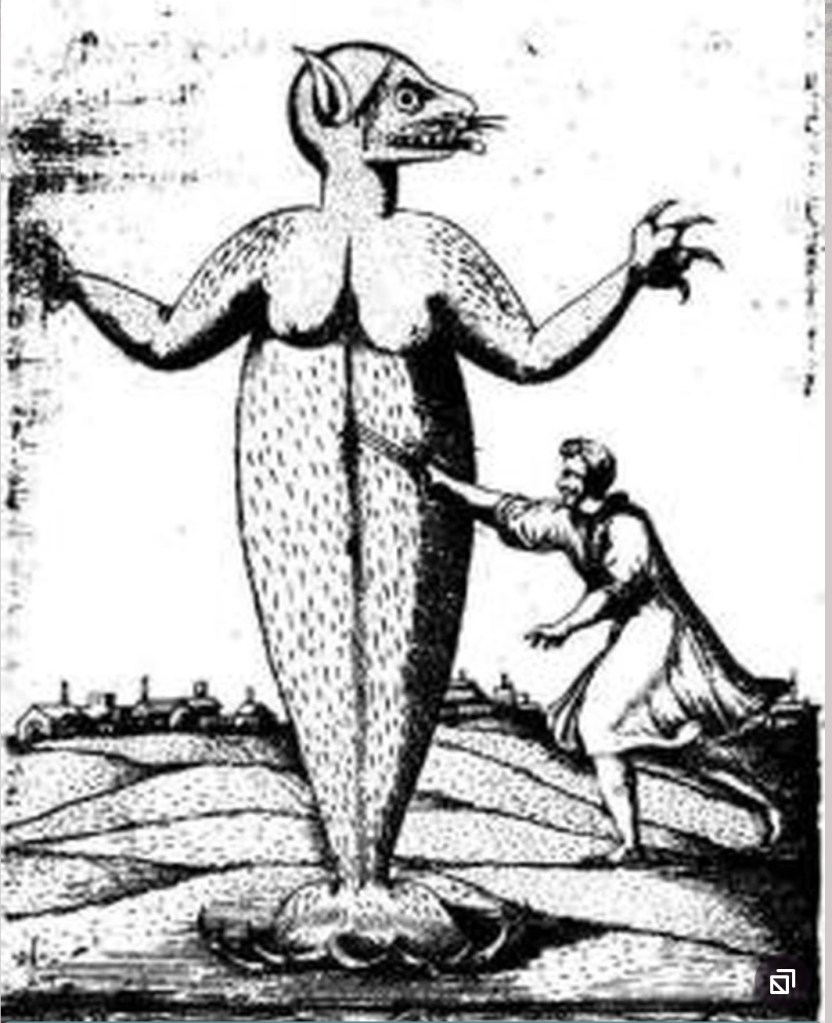
The Sea Lion as originally described in the 1500s from The John Carter Brown Library
For the second in a series of curious creatures once the cryptids of their time, we talk about the sea lion.
I can imagine a sea lion must have been quite a site if you had no knowledge or experience with one, I’d probably still want to pat one even then. But let’s take a look at one of it’s first sightings in Brazil in the 1500s…
In 1564, when the Portuguese had just arrived here, they found a monster on the beach? That’s right. It was where the city of São Vicente is today, on the coast of São Paulo. The story goes back to Pero de Magalhães Gândavo, one of our first historians. He says that, one night, the Indians pulled out of the sea a creature that measured more than 3 meters in length, full of fins and hair all over its body, “and on its snout it had very large silks like whiskers”. They named it ipupiara, or water demon in ancient Tupi.”
A text from that time tells a tale that goes a little like this;
Explorer Baltasar Ferreira killed this marine monster off the coast of São Vicente (present-day Santos in the state of São Paulo) in 1564. The monster is described as being 15 palms long, covered with hair, and with silky bristles like a mustache on its muzzle.
Today they say they still aren’t sure what the creature really was, but it is thought to be a lost sea lion that swam into their waters. A statue of the creature, which is thought to be what inspired the Creature from the Black Lagoon and The Shape of Water, still stands today…
We in the cryptozoology community post often about the beloved thylacine, but for me the part of its history I have a hard time coming to terms with is its last days at the zoo and the films which appear to be a dank miserable zoo environment.
But how was their care really? Who ran that zoo? Maybe if we know a little bit about that it may be easier to study the last of these amazing creatures.
It turns out that this zoo wasn’t as uncaring as the video made it seem by its age and quality.
Mary Robert with her thylacines
A women named Mary Roberts opened the Beaumaris Zoo on her property in Hobart in 1875.
Mary had no formal schooling in zoology, but she did have a passion for Tasmanian fauna. Mary began sharing her passion with the general public in 1895.
Her great love and care for the thylacine was well known. She became the first woman to successfully breed them in captivity. So loved by her they were, that she wrote a manual on the keeping, caring, and breeding of the thylacine.
She was accepted into the Zoological Society of London, where she began gaving lectures on the care of these amazing marsupials.
In 1921 Mary Roberts passed away and the zoo and its many inhabitants were offered to the Tasmanian government, who declined the offer sadly. Then they were cared for by a Scottish farmer who was a great nature enthusiast. The Beaumaris Zoo was eventually moved to a location in Queens.
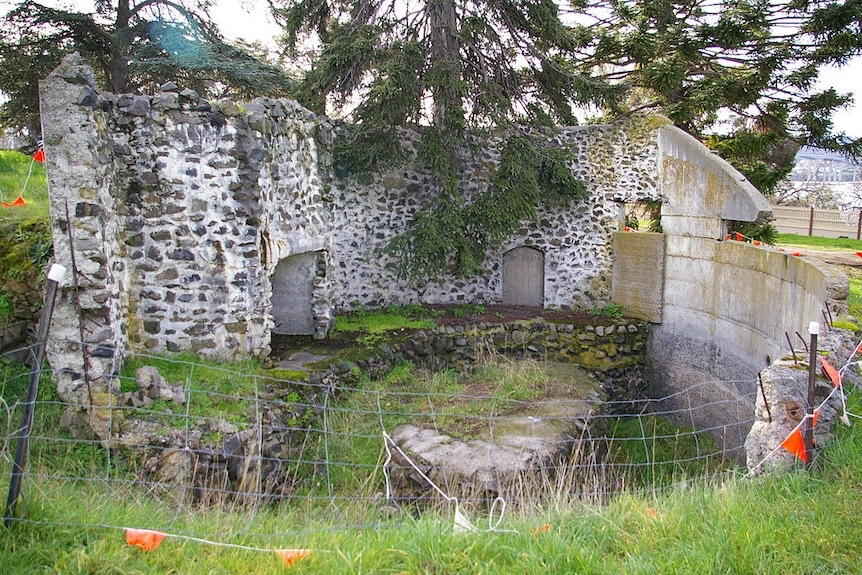
Sadly the last known living tiger died in 1936, the zoo itself closed a year later in 1937. There are only a few remains left of the zoo’s buildings where it stood last…
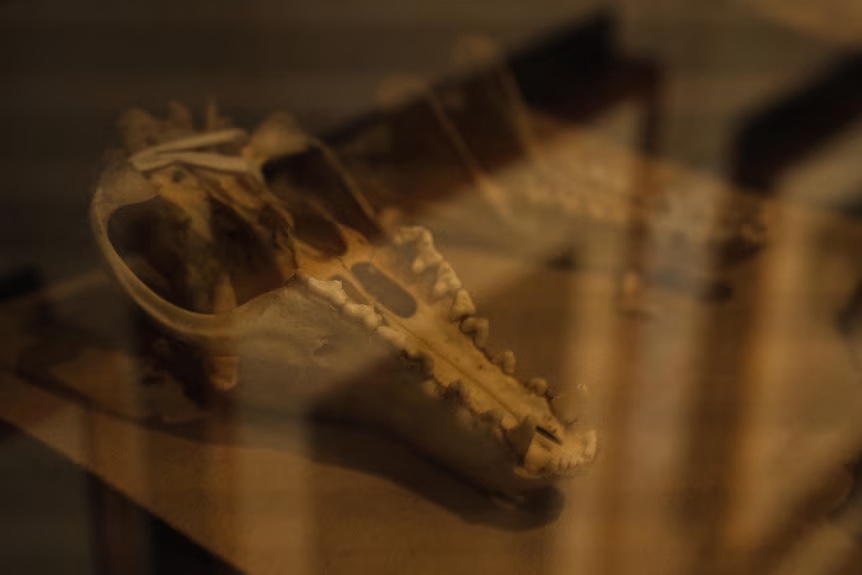
The skull of the last thylacine
The remains of the last thylacine were given to the Tasmanian Museum and Art Gallery, who being unaware they had the last specimen of its kind, did a traveling exhibit with them instead of working on proper storage and cataloguing.
But how does all this make you feel now? Is it better to see those videos knowing Mary Roberts truly cared for them and tried to educate everyone on their proper care?
The Tiger enclosure
For me personally it makes it a little better understanding their history with at least their time with her. I still question their care in their last days . They appear so skinny in the videos, and just knowing the last one died due a cold spell, because they weren’t put in the proper habitat that night just doesn’t help me.
I pray they had some affection along the way. And as much as I would love to see these elusive creatures alive, I don’t agree with the de-extinction plan for them.
Humans are doing a number on this planet causing extinction and near extinction of many of its species. So the idea that it would be a good thing to bring them back in a time we are killing off others just doesn’t make sense and seems highly unethical to me.
What are your thoughts on the de-extinction of the thylacine? Do you think this world can support and keep them alive now in its current state? Let me know.
Crews found not one, but two strange footprints in his niece’s driveway near Payne’s Chapel Road, just two miles from the Bulloch/Jenkins County line Tuesday. The prints appear humanlike, but only show four toes. The largest measures 19″ long and 11″ wide, and was way deeper than Crews was able to make one of his own prints, and he weighs about 250 pounds. In fact, the off prints dwarf his size 13 EEE shoe prints, he said. Crews’ niece was taking her children to the end of the driveway Tuesday morning when she spotted the prints and called Crews. “She said she heard the dogs, which were in the house, raising cain around 4 a.m.,” he said. “They wouldn’t shut up.”
Sasquatch men, remnants of a lost race of “wild men” who inhabited the rocky regions of British Columbia centuries ago, are reported roaming the province again.
After an absence of several months from the district of Harrison Mills, 50 miles east of Vancouver, the long, weird wolf- like howls are being heard again and two of the hairy monsters were reported seen in the Morris Valley on the Harrison river.
Residents in the district tell of seeing the two giants leaping and bounding out of the forest and striding across the duck-feeding ground, wallowing now and again in the bog and mire and long waving swamp grasses.
The strange men, it was reported, after emerging from the woods, came leaping down the jagged rocky hillside with the agility and lightness of mountain goats.
Snatches of their weird language floated on the breeze across the lake to the pioneer settlement at the foot of the hills.
The giants walked with an easy gait across the swamp flats and at the Morris Creek, in the shadow of Little Mystery Mountain, straddled a floating log, which they propelled with their long, hairy hands and huge feet across the sluggish glacial stream to the opposite side.
There they abandoned the log and climbed hand over hand up the almost perpendicular cliff at a point known as Gibraltar and disappeared into the wooded wilderness at the top of the ridge. They carried two large clubs and walked around a herd of cattle directly in their path.
The return of the giants to the legendary stronghold of the Sasquatch monsters recalls the narrow escape of an Indian at the same spot last March, a huge boulder narrowly missed his canoe while he was fishing and looking up he said he saw a huge and hairy monster stamping his feet and gesticulating wildly, The Indian escaped by cutting his fishing tackle and paddling away. The same Indian declared the Sasquatch twice have stolen salmon which he tied in a tree outside his house out of reach of the dogs The latest appearance of the monsters was peaceful. They avoided the trails usually used by the people of the valley and molested neither cattle nor human beings.
People who have reported seeing the giants on their rare appearances described them as “ferociou looking wild men, nine feet tall and covered from head to toe with thick black hair.”
The Waterbury Democrat (Waterbury, Conn.), October 31, 1935
I really enjoy these early sightings, they seem more sincere however fanciful. The rate bigfoot is currently reported being seen feels somehow less believable to me. So I almost feel more comfortable going into the past encounters than I do some present ones. And of course you also have the legendary cryptozoologists of the time as well. History has always been more my speed…
“The new research began after Javan resident and conservationist Ripi Yanur Fajar reported seeing a big cat jump between a road and a plantation near the village of Cipeundeuy in the forest of South Sukabumi in August 2019. Researchers visited the site nine days after the alleged sighting and found a hair on a nearby fence, along with potential tiger footprints and claw marks.“
The new research began after Javan resident and conservationist Ripi Yanur Fajar reported seeing a big cat jump between a road and a plantation near the village of Cipeundeuy in the forest of South Sukabumi in August 2019. Researchers visited the site nine days after the alleged sighting and found a hair on a nearby fence, along with potential tiger footprints and claw marks.
— Read on nexusnewsfeed.com/article/climate-ecology/is-the-javan-tiger-back-from-extinction-new-study-ignites-controversy/
The Javan tigerwas anative to theIndonesian island ofJava. It was one of threetiger populations that lived on the Sunda Islands during thelast glacial period. The tiger’s naturalhabitat was decreasing continuously as more land were needed for agriculture. Since no evidence of a Javan tiger was found during several studies in the 1980s and 1990s, it was determined that it was extinct in 2008.











 Sasysquatchgirl