“In the 1990s, a strange creature emerged from the Brazilian Amazon Basin. Known as the Holadeira, or “sawtooth dolphin,” this cryptid was reportedly spotted by local and named the Holadeira and it even captured the attention of adventurers like Jeremy Wade.
Wade reportedly first saw the animal in 1994 about 100′ away from his boat while fishing. With its notched dorsal fin and elusive nature, some believe it was a unique species, while others think it might have been an injured Amazon river dolphin.
Wade, after witnessing it again and being able to photograph it on his second expedition out there, confirmed it was a dolphin, perhaps mutilated by fisherman…
I was reminded of this little legend on Reddit , if you’d like to keep up with the conversation on it over there here is the link…
In the late 1960s, a Soviet historian became fascinated with reports of a giant ape-like beast roaming the mountains of Central Asia. His obsession led him to develop an elaborate theory that these sightings were not of a mysterious cryptid, but of surviving Neanderthals who had endured since the last ice age.
Born in 1905, Boris Porshnev was a Soviet historian who dedicated much of his career
to studying mainstream academic topics, like popular uprisings in 17th-century France and the Thirty Years’ War. However, his scholarly pursuits were later peppered with an unorthodox interest in cryptozoology, especially the strange reports of the so-called Almas.
For centuries, reports of the Almas have emerged from people living within the mountain system of Central and East Asia, including Mongolia, the Altai and Tian Shan Mountains, Xinjiang, Gansu and Qinghai in China, and the Tuva Republic in Siberia.
As reports continued to surface, Porshnev secured approval from the Soviet Academy of Sciences in the 1950s to formally investigate the Almas. In 1958, he led an expedition to the Pamirs of Tajikistan, accompanied by a team of folklore experts, geologists, and botanists. After collecting a load of anecdotal reports about local sightings, the commission compiled a 400-page report on the topic, concluding that the Almas was most likely real and residing in the region between the Tian Shan, Pamir, and Mongolia.
After the expedition, Porshnev began to suggest that the Almas were, in fact, a living Neanderthal. He had flirted with the idea in previous publications, but it was most explicitly laid out in his 1974 book called L’Homme de Néanderthal est toujours vivant (French for Neanderthal Man is Still Alive), co-authored with explorer and prominent cryptozoologist Bernard Heuvelmans.
“One must say that Porshnev and I were both quite convinced of the existence of wild hairy men in the broadest and loosest sense,” Heuvelmans wrote in the intro to Porshnev’s other book, The Struggle for Troglodytes.
“However, there was a point on which we never managed to agree: I saw the Himalayan snowman as an anthropoid ape while Porshnev saw an actual human, more specifically a Neanderthal man survivor from the recent Pleistocene,” he added. Fossilized remains of the extinct hominin species have been uncovered in this part of world.
But what do you think about his theory? I have always been on a line believing more that what ever this creature turns out to be, they have likely been here along. After all we know now thanks to more recent findings that several different types of hominids were existing side by side, might the infamous cryptid wandering out forests be one of them. I think yes. Man? Ape? Something in between most likely.
Maybe some day we’ll know for sure, hopefully in our lifetime…
Have a great day everyone and please I’d love to hear your thoughts…
A rescued Asian small-clawed otter in Dadeldhura, Nepal. Image by Rajeev Chaudhary.
As reported by Mongabay…
Scientists have for the first time in 185 years confirmed the presence of the Asian small-clawed otter in Nepal, thrilling conservationists and researchers looking for clues to its existence here.
The last time the Asian small-clawed otter (Aonyx cinereus), the smallest of the world’s 13 known otter species, was recorded by scientists in Nepal was in 1839.
“After years of speculation about its presence in Nepal, we can finally confirm that the small-clawed otter lives on in the country,” said Mohan Bikram Shrestha, the lead author of a short note published in the latest edition of the bulletin of the Otter Specialist Group at the IUCN, the global wildlife conservation authority.
Have you ever encountered a tree so colorful and magnificent that it looks as though an artist’s painting just came to life?
No? Well, meet the Rainbow Eucalyptus tree. It’s a botanical wonder that adorns the natural world with its strikingly colorful bark.
Native to the Philippines, Indonesia, and Papua New Guinea, the Rainbow Eucalyptus is a true sight to behold . Its distinctive feature is its multi-colored bark, which changes hues as the tree sheds its outer layers. As the bark peels away, it reveals an array of colors—from bright green to blue, purple, orange, and maroon. This kaleidoscope effect is due to the varying stages of maturation and exposure of the bark to the elements.
While its appearance is captivating, the Rainbow Eucalyptus also plays a vital role in its native ecosystems. It thrives in tropical climates, often found near rivers and lakes. The tree can grow rapidly, reaching heights of over 200 feet. Its towering presence provides essential shade and habitat for various wildlife species and its leaves and bark are also used by natives for medicinal purposess.
If you’re like me, and your first thought was adding this living artwork to your backyard , there are a few things here to consider. This tree requires a warm, humid environment and ample space to grow. It’s not well-suited for colder climates, as it cannot withstand frost. Which means sadly I won’t be able to grow one. However, if you live somewhere with the right conditions, you can enjoy seeing this beauty in your own yard everyday. Seeds are easy to purchase online.
The Rainbow Eucalyptus is a reminder of nature’s own incredible beauty. As we continue to appreciate and protect these unique species, we ensure that future generations can marvel at their splendor too one day. Whether you’re a nature enthusiast or simply someone who appreciates the wonders of the natural world, the Rainbow Eucalyptus is sure to leave you an awe of its marvelous colors.
I wish I could enjoy having my cup of coffee each morning sitting in my favorite chair just staring at this tree.
Do you have a rainbow eucalyptus in your yard? Let me know, better yet, send me a photo, I’d love to see one!
The Wolf Moon, the first full moon of January which shined down on us last night, carries with it a mystique that’s been woven into folklore and legends across cultures.
In Native American traditions, it is named after the hungry howls of wolves heard during the frigid winter months. These howls were thought to signify the wolves’ yearning for the sustenance and warmth that the cold, barren landscape lacked. This moon marked a period of hardship and endurance for both the wolves and the people who lived alongside them.
In other cultures, the Wolf Moon is associated with transformation and inner strength. Legends speak of mythical creatures that were said to roam under this luminous moon, including werewolves, who would shift from human to wolf under its silvery light. The eerie glow of the Wolf Moon was thought to awaken a primal instinct within, urging individuals to connect with their wild, untamed nature.
There are also tales of spiritual awakenings and mystical encounters happening beneath the Wolf Moon. It’s a time believed to be ripe for introspection, releasing old habits, and setting intentions for the year ahead. Some legends even suggest that the Wolf Moon opens a portal to the realm of spirits, allowing for communication between the earthly and the otherworldly.
It’s fascinating how a single celestial event can inspire such a rich tapestry of stories and beliefs!
And sadly, I apologize that I wasn’t able to publish this last night due to a teeny hiking injury, but, better late than never! 🌕🐺✨
This is hair ice, it’s a rare type of ice formation where the presence of a type of fungus in rotting wood produces thin strands of ice which can resemble hair or cotton candy.
One of the first records of this ice was recorded by Alfred Wegener (who also discovered the continental drift) in 1918. He observed a strange ice forming only on wet dead wood and a theorized that a specific fungi must be the catalyst for the smooth, silky hairs of ice.
Hair ice forms on humid winter nights when the temperature is just below freezing. It’s most likely to form on dead alder branches.
Hair ice resembles hair or cotton candy. Hair ice is also known as frost flowers, frost beard, or ice wool. A fungus called Exidiopsis effusa is responsible for hair ice. The fungus produces thin threads of mycelium on branches, and hair ice grows on those branches.
Hair ice is not poisonous to touch, but it is also not edible. It’s a very rare occurrence, so if you’re lucky enough to see some on your morning walks too, please take some nice photos, and if you have time send one along to me, I’d love see and share them!
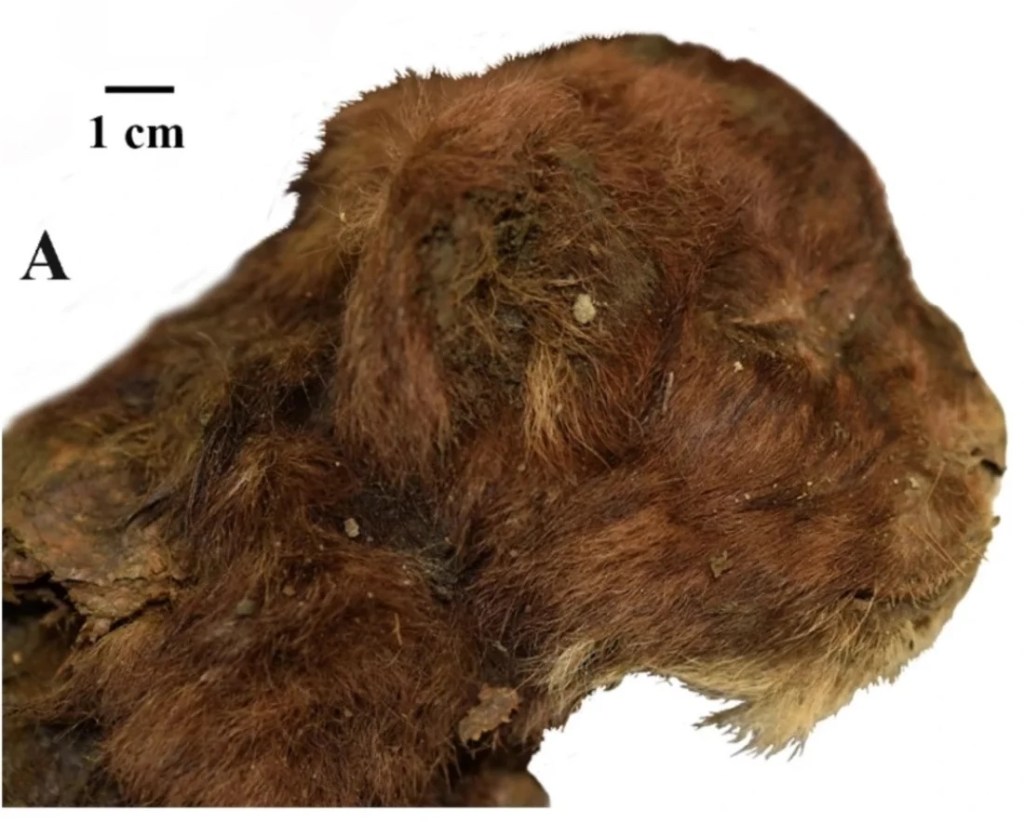
An ancient cat was found almost perfectly preserved in Siberia’s permafrost.
Researchers found the mummy of a 35,000-year-old saber-toothed cub in what is now Russia’s northeastern Sakha Republic, also known as Yakutia, in 2020
The kitten still had its whiskers and claws attached when it was pulled out of the permafrost, and was covered in a coat of “short, thick, soft, dark brown fur.” Its hair was about 20 to 30 millimeters long, according to researchers.
Sadly, we will probably hear they are going to attempt to bring them back from extinction as well, along with the wooly mammoth and thylacine tiger. We can’t even stop the current extinctions of today’s animals we are causing and they want to add to the crisis. We’ll have to wait and see what comes of it down the road…


 Sasysquatchgirl