
And now for something completely different… this weird creature called the Shunka Warak’in. Often dubbed the “Rocky Mountain Hyena” or simply “the Beast,” this wolf-like creature has slinked through Native American folklore and settler tales,and maybe even the Ice Age.
Roots in Native American Lore: The Dog-Snatcher of the Plains
Long before European settlers arrived, the Shunka Warak’in was a figure in Native American traditions, particularly among the Ioway (Iowa) tribe and neighboring groups like the Lakota and Shoshone in the Great Plains and Midwest regions. The name itself, “Shunka Warak’in,” translates roughly to “carries off dogs” in the Ioway language, fitting for a beast notorious for sneaking into villages under the cover of night to snatch canines right from under their owners’ noses.
Descriptions from oral histories paint it as larger than a wolf, with dark, shaggy fur, high shoulders, and a sloping back that gives it a hyena-like silhouette. It wasn’t just a scavenger; this cryptid was bold, aggressive, and eerily unintimidated by humans or campfires. Tribes like the Ioway distinguished it clearly from ordinary wolves, they knew their local wildlife intimately, and this was something else to them.
One tale, shared by Ioway historic preservationist Lance Foster, recounts a fierce battle where warriors slew a Shunka Warak’in. Victorious, they fashioned pieces of its hide into sacred war bundles or medicine pouches, believing the creature’s resilience would make them “as hard to kill” as the beast itself. In these cultures, the Shunka Warak’in wasn’t merely a monster; it symbolized the perils of the untamed frontier.
Pioneer Encounters: Excerpts from a Naturalist’s Memoir
Fast-forward to the late 1800s, when white settlers in Montana’s Madison River Valley began reporting encounters that eerily mirrored the Native tales. The most famous account comes from rancher Israel Ammon Hutchins, whose story was immortalized by his grandson, zoologist Ross E. Hutchins, in the 1977 book Trails to Nature’s Mysteries: The Life of a Working Naturalist (with a 1997 reprint).
Hutchins recounts his grandfather’s chilling brushes with the creature in vivid detail. One excerpt describes an early sighting:
“One winter morning my grandfather was aroused by the barking of dogs. He discovered that a wolf-like beast of dark color was chasing my grandmother’s geese. He fired at it but missed and ran off towards the river.”
The beast returned repeatedly, prompting more confrontations. Eventually, Israel succeeded: “Then one morning in late January, my grandfather was alerted by the dogs, and this time he was able to kill it.” Witnesses described it as “nearly black and having high shoulders and a back that sloped downward like a hyena.”
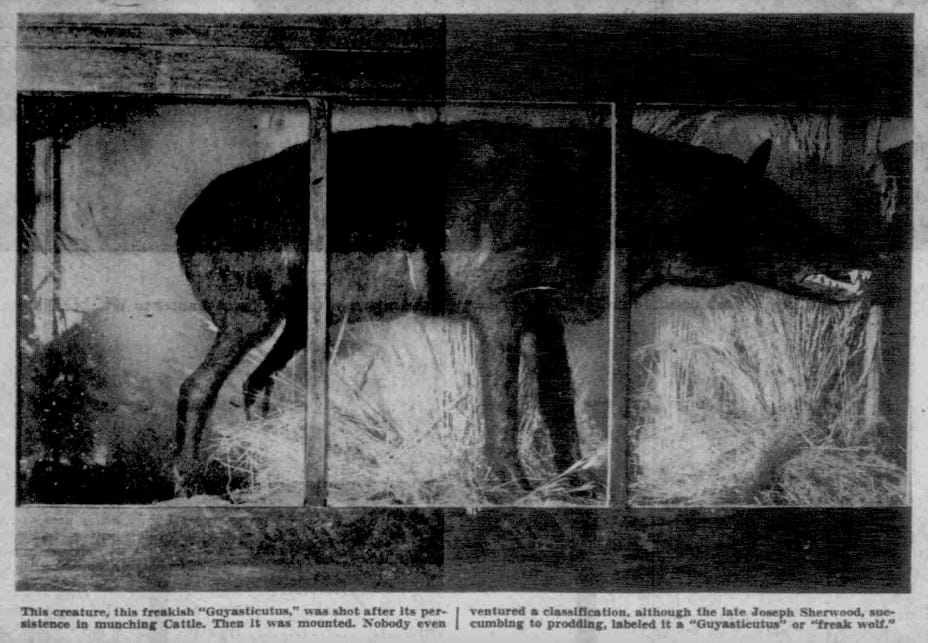
The carcass was traded to taxidermist Joseph Sherwood, who mounted it and displayed it as the “ringdocus” or “guyasticutus”, quirky names for what became a local curiosity. It vanished for decades, known only from a grainy photo in Hutchins’ book, until its rediscovery in 2007 at the Idaho Museum of Natural History (now on display at the Madison Valley History Association Museum in Ennis, Montana).
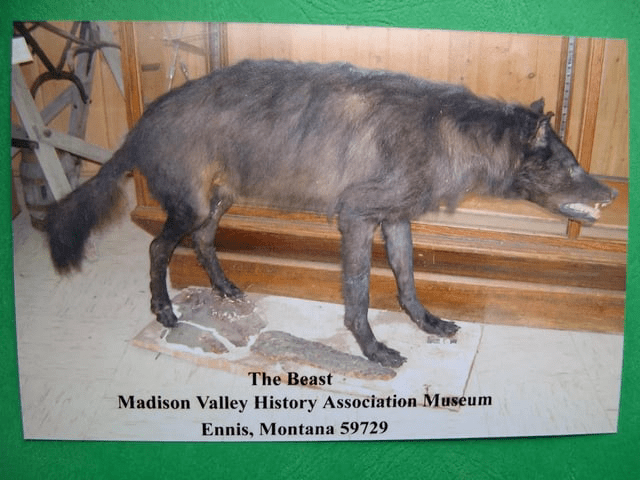
Ross Hutchins, with his scientific background, couldn’t classify it definitively, speculating it might be an escaped hyena but noting the improbability.
Echoes from the Ice Age: The Running Hyena Connection
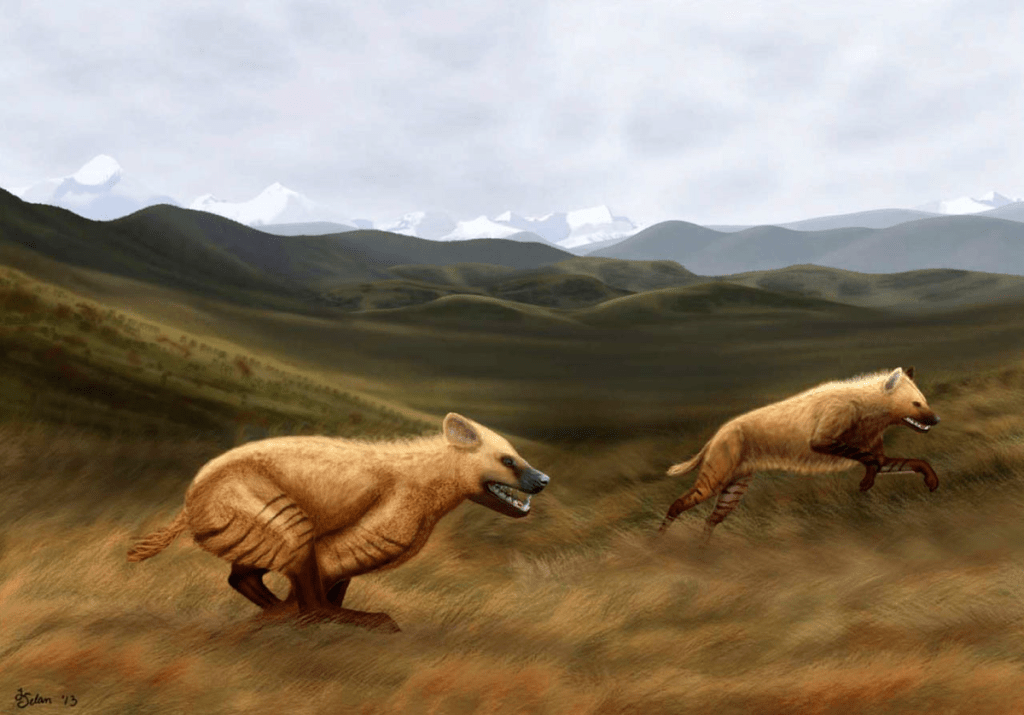
What if the Shunka Warak’in isn’t just myth or legend, but a remnant of prehistoric North America? Cryptozoologists often compare it to Chasmaporthetes ossifragus, the “running hyena” or “American hyena”, an extinct species that roamed the continent during the Pliocene to Pleistocene epochs (about 4.9 million to 780,000 years ago).
Unlike the bone-crushing hyenas of today, Chasmaporthetes was built for speed with long legs for chasing prey across the grasslands, with a hyena-like build but more wolfish agility. Originating in the Old World (possibly Africa, Europe, or Asia), it crossed the Bering Land Bridge into North America around 5-3 million years ago, spreading south to areas like Arizona, Texas, Florida, and Mexico. Fossils are rare and fragmentary, but recent finds extend its range northward, even into Beringia and above the Arctic Circle.
This was a top predator on the Pleistocene plains, hunting pronghorns and other fast game. Its sloping back and powerful shoulders match Shunka descriptions, fueling theories of a relict population surviving into modern times perhaps even explaining those pioneer sightings.
Wrapping Up the Mystery: Fact, Fiction, or Fossil Survivor?
The Shunka Warak’in has sightings reported from Ioway warriors, Montana ranches and possibly Ice Age fossils. Is it a misidentified wolf? An escaped exotic pet? Or maybe did this creature survive, evolve and adapt from its ice age ancestors?
Have you heard of or had an encounter with this cryptid of legend, let me know…
Have a great Thursday!

 Sasysquatchgirl